
Editorial
When Nigeria’s Elite Choose Foreign Classrooms, What Does It Say About Our Universities?

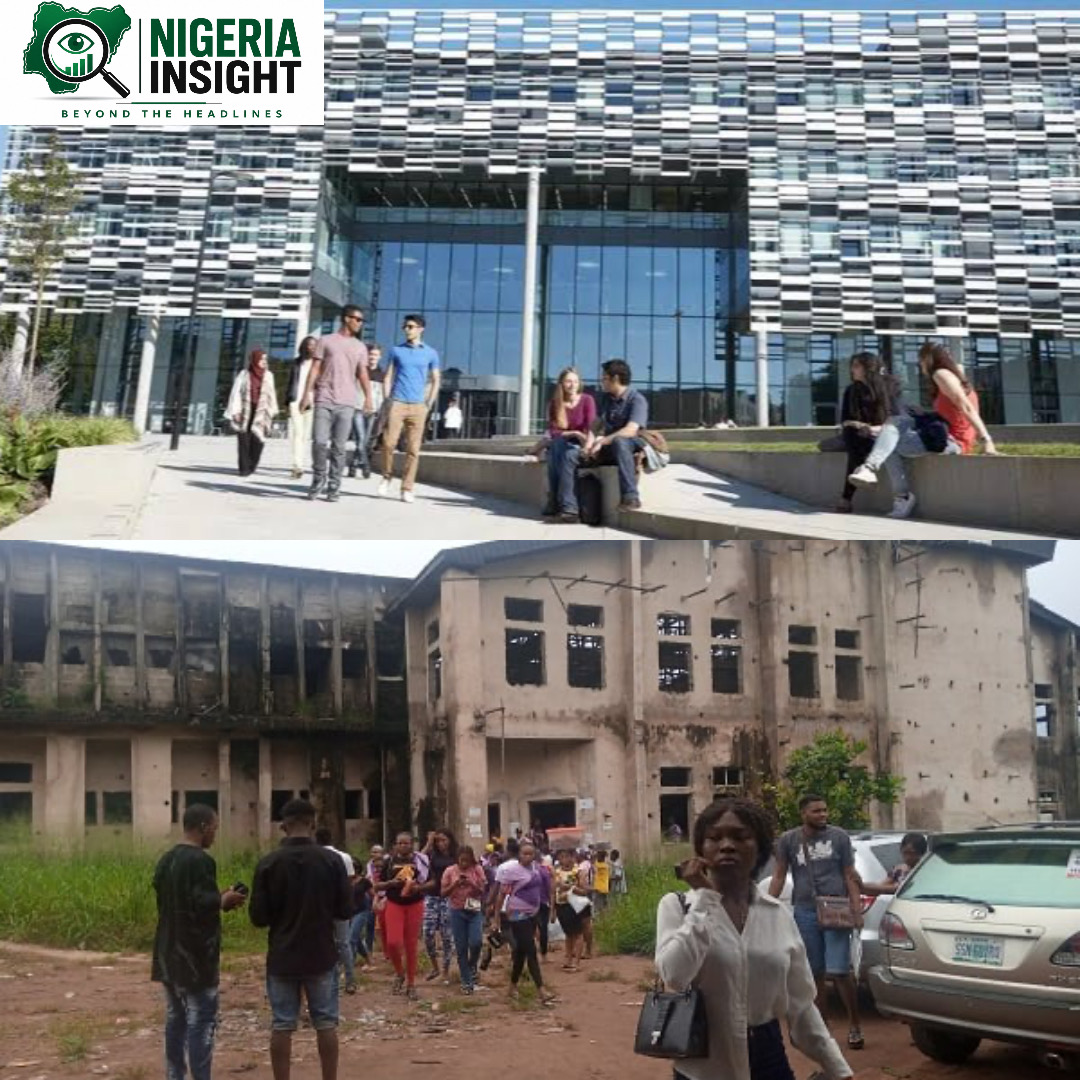
The news that Ariwera Jonathan, son of former President Goodluck Jonathan, has graduated from Manchester Metropolitan University in the United Kingdom is, on its own, a personal achievement deserving of congratulations.
Education should always be celebrated, wherever it is obtained.
Yet, beyond the applause lies a familiar question that resurfaces almost every year whenever the children of Nigeria’s political leaders graduate from universities abroad:
Why do those entrusted with improving Nigeria’s education system so often choose to educate their own children elsewhere?
It is a question that transcends political parties and administrations. From presidents and governors to ministers, lawmakers and senior public officials, a significant number of Nigeria’s political elite continue to send their children to universities in the United Kingdom, the United States, Canada and other countries, while public universities at home struggle with inadequate funding, ageing infrastructure, academic disruptions and declining global competitiveness.
This is not about one family.
It is about a national pattern.
For decades, successive governments have promised to reform education. Every administration has spoken about building world-class universities, improving research, modernising laboratories and creating an environment where Nigerian students can compete globally.
Yet the reality confronting many students tells a different story.
Lecture halls remain overcrowded. Laboratories are outdated. Student hostels are overstretched. Industrial actions have repeatedly disrupted academic calendars, leaving thousands of students uncertain about when they will graduate.
Many institutions continue to battle shortages of teaching staff, unreliable electricity, poor internet connectivity and insufficient research funding.
Ironically, many of the foreign universities patronised by Nigeria’s elite benefit financially from Nigerian families.
Billions of naira leave the country each year in tuition fees, accommodation costs and living expenses, effectively exporting resources that could help strengthen domestic institutions if invested wisely.
The issue is not that studying abroad is wrong.
Indeed, exposure to international education can broaden perspectives, encourage innovation and foster global collaboration.
Parents naturally seek what they believe is the best education for their children, and political leaders are no exception.
The real concern is the contrast between private choices and public responsibility.
When public officials express confidence in the policies they implement, citizens expect to see that confidence reflected in their actions.
If those responsible for shaping Nigeria’s education system consistently prefer foreign institutions for their own families, many Nigerians understandably ask whether this signals a lack of faith in the system they oversee.
Public confidence is built not only through speeches and policy documents but also through example.
Imagine the message it would send if more senior public officials proudly enrolled their children in Nigerian universities because they genuinely believed those institutions offered education comparable to the world’s best.
Such confidence could inspire renewed public trust and encourage greater investment in local institutions.
The challenge before Nigeria is not merely to discourage foreign education but to make it a matter of choice rather than necessity.
That requires sustained investment in infrastructure, competitive remuneration for lecturers, modern research facilities, curriculum reforms, stronger university governance and stable academic calendars.
It also demands accountability for education budgets and long-term policies that extend beyond electoral cycles.
Countries that now attract international students did not achieve that status overnight. They invested consistently in knowledge, innovation and academic excellence over many decades.
Nigeria possesses talented academics, brilliant students and universities with enormous potential. What has often been lacking is the political will to provide sustained support and reform.
As Nigerians celebrate another graduate succeeding on the global stage, perhaps the greater national conversation should not be where our leaders’ children study, but why millions of Nigerian parents still feel that quality education is easier to find outside their own country than within it.
Until that question is answered with meaningful reforms rather than recurring promises, stories of Nigerian leaders celebrating foreign degrees will continue to provoke admiration and uncomfortable reflection.


Editorial
Welcome to Nigeria Insight: A New Voice for Truth, Accountability and National Conversation
For every nation, there comes a time when the quality of public conversation becomes as important as the quality of leadership itself.
In an era where information travels faster than verification, where opinions often overshadow facts, and where sensational headlines frequently drown out thoughtful analysis, the need for credible, independent journalism has never been greater.
Today, we are proud to introduce Nigeria Insight.
Nigeria Insight is more than a digital news platform. It is a commitment, a commitment to journalism rooted in truth, fairness, independence, and the public interest.
We are founded on the belief that citizens deserve more than breaking news; they deserve context, clarity, and insight. Our responsibility is not only to report what happens, but to explain why it matters and what it means for the future of our nation.
Nigeria stands at a defining moment in its history. The country continues to confront complex questions about governance, economic reform, security, democratic institutions, social cohesion, and national development.
These issues cannot be understood through headlines alone. They demand careful reporting, rigorous analysis, and informed public debate.
That is the purpose of Nigeria Insight.
Our newsroom will cover politics, governance, elections, public policy, the economy, security, justice, and civic affairs with professionalism and editorial discipline.
We will pursue stories that hold public institutions accountable, examine policies that affect ordinary Nigerians, and provide balanced reporting that helps readers distinguish fact from speculation.
Independence is at the heart of our work. Nigeria Insight is not affiliated with any political party, government, religious organisation, ethnic interest, or commercial group.
Our editorial decisions will be guided solely by evidence, fairness, and the public interest. We believe journalism must remain free from undue influence if it is to earn and keep the trust of its audience.
We also recognise that journalism carries responsibilities as well as rights. Every report published by Nigeria Insight will be held to the highest standards of verification, accuracy, and ethical conduct.
Where mistakes occur, we will acknowledge and correct them transparently. Where opinions are expressed, they will be clearly identified as such. Where allegations are made, fairness will require that all affected parties have an opportunity to respond.
Our commitment extends beyond reporting events. We seek to foster a national conversation that is informed rather than inflammatory, inclusive rather than divisive, and constructive rather than cynical.
Nigeria’s diversity is one of its greatest strengths, and our coverage will reflect voices from every region, profession, generation, and community, including Nigerians living across the world.
To our readers, we make this promise: Nigeria Insight will never knowingly sacrifice accuracy for speed, truth for popularity, or integrity for influence.
We understand that trust is earned article by article, headline by headline, and day by day. That trust will remain our most valuable asset.
As we embark on this journey, we invite you to become active participants in building a more informed society. Read our reports with a critical mind.
Share your perspectives respectfully. Challenge us when we fall short. Hold public institutions accountable, and hold us to the same standard.
The future of Nigeria will be shaped not only by those who govern, but also by citizens who are informed, engaged, and willing to participate in democratic life. Journalism has an indispensable role to play in that process.
Nigeria Insight is honoured to begin that work today.
This is only the beginning.
Welcome to Nigeria Insight.
Beyond the Headlines.
-
 Judiciary | Public Safety1 day ago
Analysis: Why Would Mary Habila’s Father Oppose an Autopsy?
-
 Judiciary | Public Safety4 hours ago
Supreme Court Restores Final Forfeiture of Emefiele’s Seven Luxury Properties
-

 Security5 hours ago
Kogi Rescues Abducted NECO Candidates as Governor Ododo Reaffirms No-Ransom Policy
-

 Sports2 days ago
Stanley Nwabali Opens Up on Family Tragedy and Mental Health Before Chippa United Return
-

 Investigations/Anti-Corruption1 day ago
Court Orders Final Forfeiture of 48 Properties Linked to Former AGF Abubakar Malami
-

 Analysis | Security | National Affairs13 hours ago
Analysis: Why Military Recruitment Appears Lower in Nigeria’s South-East
-

 Judiciary | Public Safety3 hours ago
Lagos Gov’t Urges Residents to Adopt Responsible Waste Disposal to Combat Flooding
-
Uncategorized1 week ago
Hello world!