
Judiciary | Public Safety
INEC Tells Court Voter Information Is Not Confidential in Emeka Ike’s ₦10bn Lawsuit


The Independent National Electoral Commission (INEC) has told a court that information contained in Nigeria’s voter register is not confidential, arguing that the Electoral Act 2026 provides for public access to such records.
The electoral body made the submission while defending itself in a ₦10 billion lawsuit filed by Nollywood actor Emeka Ike, who is challenging the alleged disclosure and use of his voter information.
In its defence before the court, INEC argued that the Electoral Act permits members of the public to access certain voter registration information under specified conditions.
The commission maintained that the voter register is a public document and that the law does not classify the information contained in it as confidential.
INEC urged the court to dismiss the claims against it, insisting that it acted within the provisions of the law.
Emeka Ike instituted the suit, seeking ₦10 billion in damages, alleging that his voter information was unlawfully disclosed and that his rights were violated.
The actor is asking the court to determine whether the release or publication of his voter information breached his constitutional right to privacy and applicable data protection laws.
The court is expected to examine the arguments presented by both parties before delivering its judgment.
The suit has drawn attention to the balance between public access to electoral records and the protection of personal information.
Legal analysts say the outcome could provide judicial clarification on the extent to which voter information is protected under Nigeria’s electoral and data privacy laws.
The case also comes amid growing public awareness of digital privacy and the handling of citizens’ personal data by public institutions.
The court’s eventual decision could have broader implications for electoral transparency, access to public records and the protection of personal data in Nigeria. It may also shape future interpretations of the Electoral Act and data privacy regulations.










The Federal High Court in Abuja has sentenced three men to life imprisonment for their involvement in the abduction of schoolchildren and teachers in Oriire Local Government Area of Oyo State, rejecting pleas for leniency from the defence.
The convicts, Abdulrazak Umar (also known as Abu Khalifa/Abu Khalid), Yunusa Musa (also known as Yunusa bin Musa) and Shamsu Adamu Sani (also known as Abu Itisar) — had pleaded guilty to terrorism-related charges brought against them by the Federal Government.
During the sentencing hearing, defence counsel urged the court to temper justice with mercy, arguing that the defendants had admitted their crimes, expressed remorse and deserved a second chance.
The lawyer also told the court that the convicts were responsible for the welfare of their wives, children and elderly parents, asking the judge to impose a lighter sentence.
Justice Salim Ibrahim dismissed the request for leniency, ruling that the seriousness of the offences warranted a life sentence.
The judge ordered that the life imprisonment terms would take effect from the exact date of the convicts’ arrest, ensuring that the time already spent in custody would count toward the sentence.
The three men were prosecuted in connection with the May 2026 attack on schools in Oriire LGA, where dozens of pupils and teachers were abducted by suspected terrorists linked to the Ansaru group before they were rescued in a joint security operation weeks later.
The ruling is one of the first major convictions arising from the high-profile Oriire school abduction, an incident that sparked nationwide concern over the spread of terrorist activities into Nigeria’s South-West.
The judgment underscores the Federal Government’s efforts to prosecute individuals linked to terrorism and mass kidnappings through the judicial process.
The conviction sends a strong signal that terrorism and school abductions will continue to attract severe legal consequences.
It also highlights the role of the courts in complementing security operations aimed at tackling kidnapping and terrorism across Nigeria.
The Federal High Court is expected to deliver its ruling on Friday on an application by the National Drug Law Enforcement Agency (NDLEA) seeking approval to destroy a clandestine methamphetamine laboratory valued at approximately ₦480 billion in Ogun State.
The agency is asking the court to authorise the destruction of the illicit drug production facility, describing it as one of the largest methamphetamine laboratories uncovered in Nigeria.
The application follows the discovery and dismantling of the suspected meth lab during an anti-narcotics operation in Ogun State.
According to the NDLEA, the facility was allegedly used for the large-scale production of methamphetamine, a highly addictive synthetic drug linked to organised crime and substance abuse.
The agency told the court that preserving the laboratory poses security and environmental risks, hence its request for judicial approval to destroy the facility.
The case forms part of the NDLEA’s intensified crackdown on drug trafficking syndicates and illegal drug manufacturing across the country.
In recent months, the agency has announced several major seizures of narcotics, arrests of suspected traffickers and the dismantling of clandestine laboratories as it seeks to curb the production and distribution of illicit drugs.
Officials say the operations are aimed at disrupting criminal networks while reducing the availability of dangerous substances within Nigeria and beyond.
The Federal High Court is expected to determine whether the agency has met the legal requirements for the destruction of the facility and related exhibits.
The ruling could set the stage for the safe disposal of the laboratory under the supervision of relevant authorities if the application is granted.
Methamphetamine production remains a major security and public health concern due to its links to organised crime, addiction and transnational drug trafficking.
The court’s decision could mark another milestone in Nigeria’s efforts to dismantle illegal drug manufacturing operations and strengthen the fight against narcotics.
Judiciary | Public Safety
Calabar Court Sentences Pastor to Death for Killing Daughter Over Witchcraft Allegation


A High Court in Calabar, Cross River State, has sentenced Apostle Ubong Bassey Etim, 51, to death by hanging after finding him guilty of the murder of his 16-year-old daughter, Deborah Bassey.
Justice Rosemary Dugbo Oghoghorie delivered the judgment after concluding that the prosecution had proved its case beyond reasonable doubt.
The court held that the defendant unlawfully caused the death of the teenager, who had been accused of witchcraft.
According to the prosecution, Deborah Bassey was subjected to abuse after being accused of practising witchcraft before she eventually died.
After reviewing the evidence presented during the trial, the court convicted Apostle Etim of murder and imposed the death sentence prescribed under the law.
The judge ruled that the prosecution successfully established the elements of the offence and that the evidence justified a conviction.
The judgment has renewed public attention on the dangers of witchcraft accusations against children, a practice that child rights advocates have consistently condemned.
Organisations working to protect children have long warned that allegations of witchcraft often expose minors to violence, abuse, abandonment and, in extreme cases, death.
They have continued to call for stronger enforcement of child protection laws, public awareness campaigns and the prosecution of offenders.
The case underscores Nigeria’s ongoing efforts to protect children from harmful traditional beliefs and abuse.
It also highlights the role of the judiciary in enforcing accountability for crimes committed against minors, regardless of the relationship between the accused and the victim.
-
 Breaking News2 weeks ago
Girl Dies in Uyo House Fire After Allegedly Accompanying Man Home from Nightclub
-

 News2 weeks ago
NEMA Urges Residents in Flood-Prone Areas to Relocate as Heavy Rains Intensify
-
 Security2 weeks ago
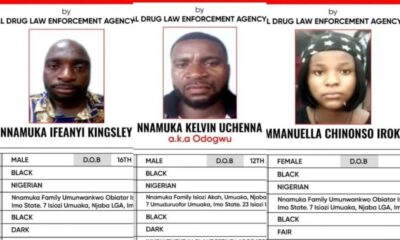
NDLEA Declares Alleged Drug Kingpin, Three Associates Wanted, Freezes ₦9.8bn Linked to Syndicate
-

 Judiciary | Public Safety3 weeks ago
Analysis: Why Would Mary Habila’s Father Oppose an Autopsy?
-
 Editorial3 weeks ago
When Nigeria’s Elite Choose Foreign Classrooms, What Does It Say About Our Universities?
-
 National Affairs2 weeks ago
ICPC Uncovers 908 Suspected Ghost Workers Across 50 Federal MDAs, Recovers ₦942 Million
-
 Judiciary | Public Safety2 weeks ago
Court to Rule Friday on NDLEA’s Bid to Destroy ₦480bn Meth Lab in Ogun
-

 2027 Elections7 days ago
Naira Redesign, Buhari-Era Hardship Helped Peter Obi Defeat Tinubu in Lagos, Says Oshiomhole