
National Affairs
FG Launches National Peace Framework to Improve Security, Social Cohesion


The Federal Government has unveiled a National Framework for Peace, Social Cohesion and Resilience aimed at strengthening conflict prevention, improving peacebuilding efforts and coordinating national security interventions across government institutions and communities.
The framework was launched in Abuja, according to a statement issued on Thursday by Amina Wali of the Office for Strategic Preparedness and Resilience (OSPRE), National Centre for the Coordination of Early Warning and Response Mechanisms.
The initiative is designed to provide a common platform for government institutions, security agencies, state peace commissions and civil society organisations to coordinate efforts towards sustainable peace and national stability.
OSPRE developed the framework in collaboration with Triple Peace Africa, with support from the European Union and the German development agency, GIZ.
It added that several ministries, departments and agencies, state peace commissions and civil society organisations had subscribed to the framework’s principles and strategic objectives.
The framework is expected to serve as a reference point for coordinating interventions, mobilising resources and strengthening the links between early warning, early response, conflict resolution, social cohesion and sustainable development.
The Federal Government said the launch marks the beginning of a new phase focused on institutional adoption and implementation of the framework.

The Kwara State Government has expressed its readiness to partner with private-sector investors to boost livestock production, develop the dairy value chain and improve the livelihoods of farmers across the state.
The Commissioner for Livestock Development, Oloruntoyosi Thomas, disclosed this on Thursday after a meeting with representatives of FrieslandCampina WAMCO, a major player in Nigeria’s dairy and food industry.
The meeting focused on exploring potential areas of collaboration in livestock production, agricultural development and investment opportunities aimed at strengthening the state’s agricultural sector.
Thomas said the engagement was part of the government’s efforts to attract private-sector investment, improve local production and strengthen the livestock and dairy value chains through partnerships that would benefit farmers and other stakeholders.
According to her, collaboration with FrieslandCampina WAMCO could provide local livestock farmers with access to modern agricultural practices, improve productivity and create opportunities for greater participation in the dairy industry.
She added that such partnerships could also stimulate the growth of small and medium-scale enterprises, generate employment and improve farmers’ livelihoods through stronger connections with private-sector operators.
The commissioner emphasised the importance of involving local farmers and other stakeholders in the proposed initiatives to ensure that the benefits of agricultural investments reach communities at the grassroots.
“One of the key areas of interest was the potential for stronger collaboration with local farmers and other stakeholders in the livestock sector,” Thomas said.
She maintained that partnerships of this nature would help improve farmers’ economic conditions, create employment opportunities and encourage the development of small and medium-scale businesses.
Thomas stressed that government alone could not achieve meaningful economic growth without the active participation of private-sector organisations capable of providing investment, technical expertise and innovative approaches to agricultural development.
“As a government, we recognise that meaningful economic growth cannot be achieved by government efforts alone.
It requires deliberate partnerships with credible private-sector organisations that share our vision for development,” she said.
She noted that the meeting also provided an opportunity to examine practical solutions to challenges facing the agricultural sector while creating an enabling environment for businesses to operate and expand their investments in Kwara.
The commissioner said the state had considerable potential in livestock production and agriculture, expressing confidence that appropriate policies, investments and strategic partnerships could strengthen its productive capacity.
Thomas expressed optimism that the engagement with FrieslandCampina WAMCO would result in mutually beneficial opportunities capable of advancing livestock production and contributing to Kwara’s economic development.
She, however, acknowledged that further discussions and engagements would be necessary to translate the initial conversations into concrete areas of collaboration.
“Our commitment remains clear: to build a stronger livestock sector, empower our farmers, attract meaningful investment and create a more prosperous Kwara State for all,” she said.

The Nigerian Senate has passed the Agricultural Revolution Bill, 2026, sponsored by Deputy President of the Senate, Senator Barau I. Jibrin, for second reading, paving the way for further legislative consideration of proposed reforms in the country’s agricultural sector.
The bill, identified as SB. 1082, seeks to establish a comprehensive legal framework for transforming and modernising Nigeria’s agricultural sector through improved food security, mechanisation, irrigation, agricultural financing, agro-industrialisation and climate-resilient farming.
The bill was considered during Wednesday’s plenary presided over by the President of the Senate, Senator Godswill Akpabio, days after it was stepped down over concerns about its drafting, scope and circulation to lawmakers.
Leading the debate, Barau said the proposed legislation was designed to review the agricultural sector, introduce necessary reforms and reposition Nigeria for an agricultural revolution.
The referral marks the next stage in the legislative process as lawmakers consider the proposed measures aimed at strengthening agricultural production, improving food security and promoting economic diversification.

African countries have adopted different approaches to dual citizenship, with some maintaining laws that restrict or prohibit their citizens from holding the nationality of another country.
While dual citizenship allows individuals to enjoy certain rights and opportunities in more than one country, including travel, employment and access to public services, some African governments maintain strict nationality laws based on national allegiance and citizenship regulations.
The restrictions vary across the continent. While some countries generally prohibit dual citizenship, others impose conditions on citizens who voluntarily acquire foreign nationality or restrict access to certain public offices.
Important editorial clarification: The headline’s description of all 10 countries as restricting dual citizenship needs qualification. Botswana has introduced measures recognising dual.
citizenship, while Mauritania legalised dual nationality in 2021, subject to restrictions on certain public offices. They should not be presented as outright prohibition countries.
-
 Security4 months ago
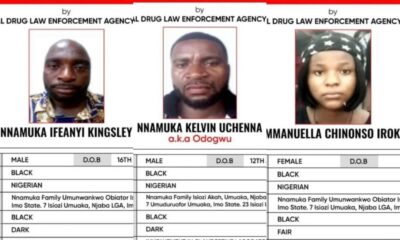
NDLEA Declares Alleged Drug Kingpin, Three Associates Wanted, Freezes ₦9.8bn Linked to Syndicate
-
 National Affairs3 months ago
ICPC Uncovers 908 Suspected Ghost Workers Across 50 Federal MDAs, Recovers ₦942 Million
-

 Business/Finance3 months ago
How to Apply for Tunde Onakoya’s ₦250 Million Scholarship Programme and Free Laptop Offer
-

 Judiciary | Public Safety4 months ago
INEC Tells Court Voter Information Is Not Confidential in Emeka Ike’s ₦10bn Lawsuit
-

 Politics3 months ago
Atiku Challenges Tinubu to Reveal Details of ₦15.13bn SUV Procurement in 2026 Budget
-
 Judiciary | Public Safety4 months ago
Court to Rule Friday on NDLEA’s Bid to Destroy ₦480bn Meth Lab in Ogun
-

 Security3 months ago
Family Paid ₦50 Million Ransom to Secure Release of Abducted Kebbi Judge
-

 News3 months ago
2026 Budget: FG Earmarks ₦962.83bn for SUVs, Empowerment Projects Amid Debt Concerns