
2027 Elections
Oyo SDP Replaces Governorship Candidate, Agboola Emerges


The Oyo State chapter of the Social Democratic Party (SDP) has replaced its governorship candidate for the 2027 election, with Mogaji Agboola emerging as the party’s new standard-bearer.
The change was ratified on Tuesday during the party’s substitution plenary held in Ibadan, where members formally approved the replacement of Mr Michael Okunlade with Agboola.
The party said the new candidate had been tasked with uniting members, strengthening the party’s structures and taking its message to all 33 local government areas of Oyo State.
The development signals a new phase in the SDP’s preparations for the 2027 governorship election, with the party leadership declaring that it is seeking more than mere participation in the poll.
According to the party, its objective is to build sufficient political strength and grassroots support to secure victory at the election.
Speaking with journalists after his emergence, Agboola said the SDP was not positioning itself for political bargaining but was determined to win the governorship election and introduce a different approach to governance in Oyo State.
Agboola said the party wanted to move away from what he described as “pedestrian thinking” and embrace system-based approaches capable of addressing the challenges of a rapidly changing society.
He said the state could no longer continue with “business as usual”, stressing that new ideas were required to transform Oyo State.
The SDP candidate said human development would be a major priority of his administration if elected, adding that his government would establish systems capable of converting the state’s human and material resources into sustainable economic opportunities.
He argued that Oyo could not continue to serve mainly as a resource centre for others, stressing the need for policies that would equip residents with relevant skills and enable them to contribute meaningfully to economic development.
Agboola also ruled out the possibility of the SDP’s governorship ticket being used for political negotiations ahead of the 2027 election.
He said the party was prepared to contest the election on its own merit and expressed confidence in its ability to take over the state.
The candidate further said he was willing to engage other governorship contenders in public debates over their policies and proposed solutions, indicating that the SDP was ready to subject its ideas to public scrutiny.
On internal party disagreements, Agboola promised an open-door policy and appealed to aggrieved members to return to the party.
Earlier, Okunlade, whose name was replaced on the SDP ticket, congratulated Agboola and described his emergence as an important development for the party.
Okunlade commended members for conducting themselves peacefully throughout the substitution process and appreciated the Independent National Electoral Commission and security agencies for monitoring the exercise.
He urged Agboola to remain committed to the party and work towards victory in 2027, stressing the importance of strengthening the SDP’s presence across the state’s local government areas and wards.
“ We want victory, not negotiation. We want commitment, not abandonment. We want unity, not division,” Okunlade said.
He also cautioned against a situation where candidates use a party platform to contest elections and later distance themselves from the party’s structures and members.
According to him, unity, commitment and effective grassroots mobilisation would be crucial to the SDP’s chances in the 2027 election.
Okunlade further responded to allegations made by another governorship aspirant concerning the substitution process and his integrity. He said he would consider legal action if any statements made against him amounted to defamation.
He subsequently urged party members and aspirants to accept the outcome of the democratic process and channel grievances through appropriate democratic and legal avenues rather than allowing disagreements to undermine the party ahead of the 2027 election.




The Obi-Kwankwaso Movement has unveiled a 59-member Presidential Campaign Council as part of its preparations to mobilise support for the proposed joint presidential ticket of Peter Obi and Rabiu Kwankwaso ahead of the 2027 general elections.
The campaign council, announced on Thursday, comprises zonal and state coordinators as well as directors overseeing mobilisation, women affairs, strategy and planning, security and intelligence, legal affairs, information technology, administration and other areas.
The Director-General of the movement, John Ughulu, was named Director-General of the campaign, while the National Secretary, Saadatu Sani, is also part of the campaign leadership.
The structure covers Nigeria’s six geopolitical zones and the Federal Capital Territory, with coordinators appointed for the 36 states.
In a message congratulating the newly appointed members, Sani described their appointments as a call to duty and urged them to take the message and political agenda of the movement to Nigerians across the country.
She said the council had been entrusted with the responsibility of communicating the vision and aspirations of the movement’s principals to Nigerians from the cities to grassroots communities, including local government areas and wards.
“Your selection is not merely an appointment; it is a call to duty, sacrifice, leadership and service to Nigeria. At this critical moment in our nation’s history, the responsibility before the Presidential Campaign Council is enormous,” Sani said.
She added that the movement’s campaign would focus on what it described as a broader national vision rather than individuals seeking personal recognition.
According to her, the movement aims to mobilise Nigerians around the possibility of a more prosperous, united and functional country.
Sani urged members of the council to approach their responsibilities with discipline, loyalty, humility and commitment to the collective objectives of the movement.
“The road ahead will require hard work. It will require strategic thinking, grassroots mobilisation, effective communication and, above all, the ability to work together as one formidable political family,” she said.
She further stated that the immediate responsibility of the campaign council was to ensure that the message of Obi and Kwankwaso reached voters across the country.
Zonal coordinators named
The movement appointed Suleiman Abubakar as North-Central coordinator, Hashimu Dungurawa as North-West coordinator, and Amadu Gwambe as North-East coordinator.
Dr Adebayo Adefolaseye was named South-West coordinator, Christopher Ighodaro was appointed South-South coordinator, while El-Shaddai Ikeh will coordinate activities in the South-East.
State coordinators were also appointed for the 36 states and the Federal Capital Territory.
Other members of the campaign council include Rev. Mike Agbon, Director of Inter-Ethnic Group in Northern Nigeria;
Sabo Gashua, Director of Grassroots Mobilisation; Glory Adayi, Director of Women Affairs; and Kabir Yahaya, Director of Contact and Engagement.
Abdumumini Tijjani was appointed Director of Mobilisation, Yusuf Mani as Director of Special Duties, Peace Daful as Director of Procurement, Prof. Charles Nwekeaku as Director of South Eastern Town Hall, and Sunmisola Adebayo as Director of Information Technology.
Kingdom Okere was appointed Director of Legal Affairs, Abiodun Dabiri as Director of Strategy and Planning, Richard Enemona, a retired Chief Superintendent of Police, as Director of Security and Intelligence, while Aisha Abdulrahaman was named Director of Administration.
The unveiling of the council is the latest move by the group to establish its campaign structure ahead of the 2027 elections.
Last month, the Obi-Kwankwaso Movement reaffirmed its decision to maintain an independent organisational structure rather than merge with another political organisation.
It also backed Ughulu as its founder and Director-General.
The movement had also recently condemned what it described as the disruption of Obi’s convoy during his visit to Benue State.
The group called for an impartial investigation into the incident and said its security personnel exercised restraint to prevent the situation from escalating.
The 59-member campaign council is expected to coordinate the movement’s mobilisation and engagement activities across the country as political activities ahead of the 2027 general elections continue to intensify.


The Independent National Electoral Commission has commenced strategic engagement with the Joint National Association of Persons with Disabilities and Organisations of Persons with Disabilities as part of efforts to increase the participation of persons with disabilities in the 2027 general elections.
The engagement, which also involved cluster heads, focused on sensitisation and mobilisation of persons with disabilities to ensure that eligible voters are adequately informed, effectively reached and meaningfully involved at every stage of the electoral process.
The initiative comes as preparations for the 2027 general elections gather momentum, with the electoral commission seeking greater inclusivity and accessibility for all eligible voters.
In a post on its X handle on Wednesday, the Acting Chairman of INEC, Prof. Rhoda Gumus, who represented the Commission’s Chairman, Prof. Joash Amupitan, SAN, said the engagement was timely.
Gumus said INEC was committed to building an electoral process that would be inclusive, accessible, participatory and responsive to the needs of all eligible citizens.
“The Commission is committed to building an electoral process that is inclusive, accessible, participatory and responsive to the needs of all eligible citizens,” she said.
She noted that the participation of persons with disabilities in elections was backed by relevant legal and policy frameworks.
These include Section 54 of the Electoral Act 2026, the Discrimination Against Persons with Disabilities (Prohibition) Act 2018 and INEC’s Framework on Access and Participation of Persons with Disabilities in the Electoral Process.
The Acting Chairman, however, stressed the need for innovative approaches to voter education to ensure that electoral information reaches persons with different forms of disabilities.
“We must explore innovative approaches to voter education, including disability-specific communication channels, community-based organisations, radio, social media and other assistive formats,” Gumus said.
INEC releases disability voter data
The Commission disclosed that its available data, compiled before the introduction of the Automated Fingerprint Identification System, recorded 137,487 persons with disabilities.
According to INEC, the figure comprises 13,080 visually impaired persons, 9,299 hearing-impaired persons, 30,561 persons with albinism, 19,430 persons with physical impairments and 54,941 persons under other disability categories.
The Commission’s engagement with disability organisations is expected to help bridge information gaps and address challenges that could prevent eligible persons with disabilities from participating effectively in the electoral process.
Gumus urged JONAPWD and the various Organisations of Persons with Disabilities to take ownership of the sensitisation campaign by reaching their members across different disability clusters.
She said members should receive timely and accurate information about voter registration, Permanent Voter Card collection, voting procedures, accessibility measures and other aspects of the electoral process.
“I urge JONAPWD and the Organisations of Persons with Disabilities to take ownership of this sensitisation process and ensure that members within your respective clusters receive timely and accurate information,” she said.
Stakeholders to identify barriers before 2027 polls
According to Gumus, the engagement also provides an opportunity for stakeholders to identify barriers that could affect the participation of persons with disabilities before, during and after the 2027 elections.
She said stakeholders would be able to share successful strategies and agree on practical measures to improve the experience of persons with disabilities throughout the electoral process.
“This engagement provides an opportunity to identify barriers to participation, share successful strategies and agree on practical actions that can be implemented before, during and after the elections,” Gumus said.
The Director of Gender and Inclusivity at INEC, Mrs Lakunuya Dorothy Bello, also highlighted some measures already introduced by the Commission to improve accessibility for voters with disabilities.
Among the measures are Braille ballot guides, magnifying glasses, the EC30 PWD form and sign-language interpretation during collation activities.
The Commission said the latest engagement forms part of its broader efforts to ensure that persons with disabilities are adequately informed and able to participate fully in the electoral process.
INEC said continued collaboration with JONAPWD, OPDs and other relevant stakeholders would be important in identifying practical solutions to accessibility challenges ahead of the 2027 general elections.
2027 Elections
2027: APC Governors Reject Parallel Structures as Wike’s Rainbow Coalition Tests Tinubu’s Political Alliance

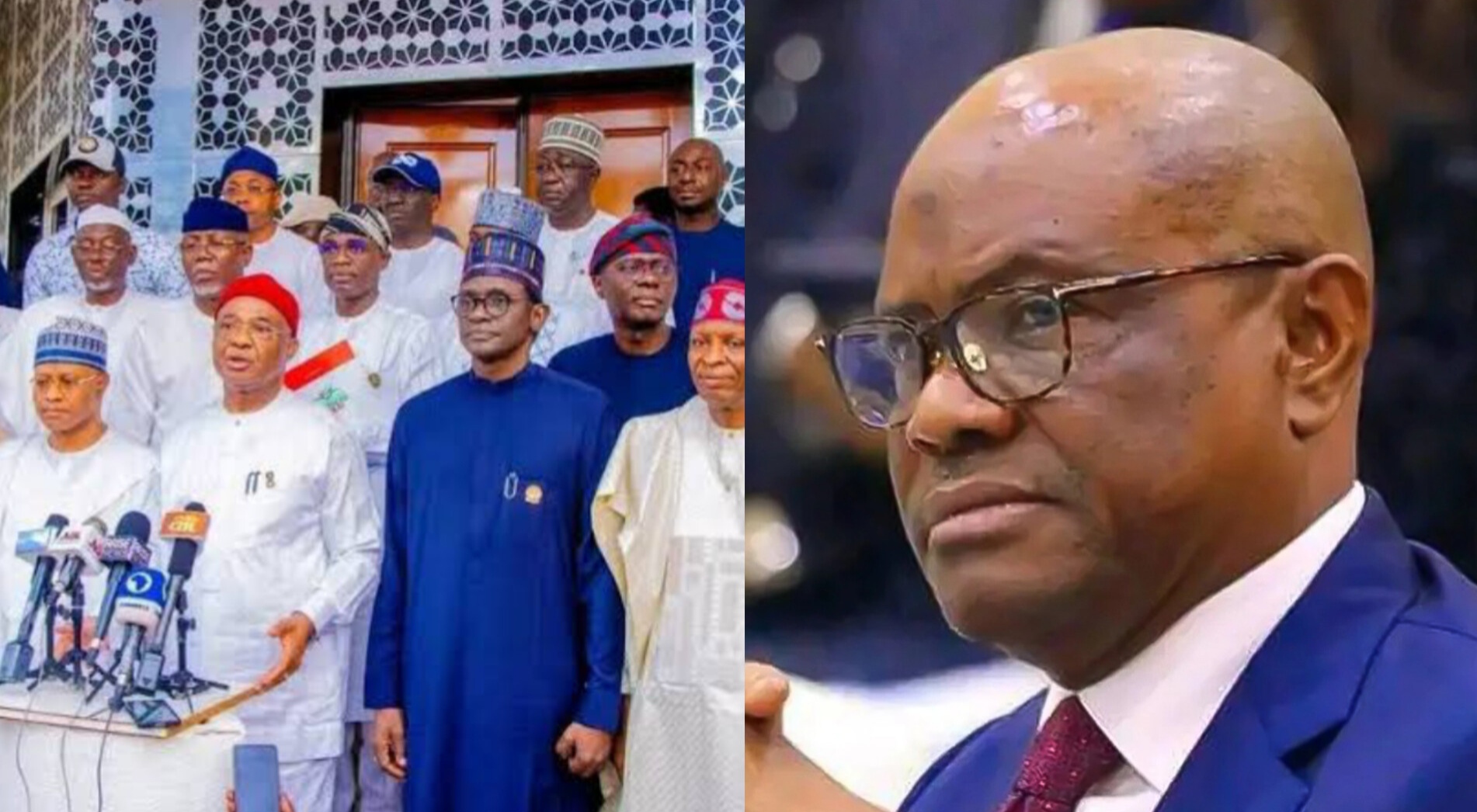
The All Progressives Congress (APC) Governors’ Forum has rejected political alliances and parallel structures that could weaken the ruling party or undermine President Bola Ahmed Tinubu’s re-election bid in the 2027 general elections.
The governors said they would not support candidates outside the APC or participate in political arrangements capable of creating divided loyalty within the party.
The position was reached at a closed-door meeting of APC governors in Abuja on Monday night and announced by the Chairman of the Progressive Governors Forum and Imo State Governor, Hope Uzodimma.
The declaration comes amid growing political tension surrounding the Rainbow Coalition associated with Minister of the Federal Capital Territory, Nyesom Wike, who remains a member of the Peoples Democratic Party (PDP) while serving in the APC-led Federal Government.
Wike has maintained that his political coalition is primarily designed to support Tinubu’s re-election in 2027.
However, the emergence of candidates and political interests operating across different party platforms has generated concern among APC governors that the arrangement could weaken the party’s candidates in governorship, National Assembly and state assembly contests.
Reading the communiqué after the meeting, Uzodimma said APC governors would remain committed to candidates officially sponsored by the party.
“The APC Governors Forum unanimously resolved that its members will not participate in, support or endorse any alliance or political arrangement capable of undermining the re-election of Mr President, weakening the APC or adversely affecting any candidate of the party at all levels,” he said.
The Imo governor added that the governors had no intention of supporting candidates who were not running on the APC platform.
He said the governors’ campaign commitment would be exclusively directed towards APC candidates, with the party’s campaign structure expected to align with Tinubu’s re-election strategy and the broader objectives of the APC.
The declaration effectively establishes a position that APC governors will not treat support for Tinubu at the presidential level as a licence to support rival candidates in other elections.
The development places Wike’s political project at the centre of an increasingly complicated calculation within the ruling party.
Wike has promoted a broad political coalition bringing together politicians across party lines while maintaining support for Tinubu’s presidential ambition.
That strategy creates a potential distinction between support for Tinubu and support for APC candidates.
For the APC governors, the concern is that a political structure capable of mobilising voters for Tinubu while simultaneously supporting candidates from other parties could weaken the ruling party’s candidates in the same election cycle.
Reports have identified growing political tensions associated with the coalition in states including Rivers, Kwara, Gombe and Cross River.
The governors’ objection is therefore not simply about whether Wike supports Tinubu. It is also about who controls the political machinery through which votes are mobilised and which candidates ultimately benefit from that machinery.
The split-ticket voting concern
At the heart of the disagreement is the possibility of split-ticket voting.
Under such an arrangement, a voter could support Tinubu for president while voting for a candidate from another party in a governorship or legislative contest.
For Wike and his allies, such an arrangement can be presented as a way of building a broad coalition around the presidency without requiring every participant to join the APC.
For APC governors, however, it creates a direct threat to the party’s candidates.
The governors’ latest resolution suggests that they want the 2027 campaign architecture to operate as a unified structure, rather than one in which different political blocs mobilise voters for different candidates.
Wike and APC governors already at odds
The latest development also follows increasingly public disagreements between Wike and some APC governors.
Wike recently alleged that Uzodimma and Kwara State Governor AbdulRahman AbdulRazaq were behind political opposition to his activities.
According to reports, Wike linked the resistance to the expansion of his Rainbow Coalition and its growing influence among politicians seeking electoral opportunities outside the APC.
The governors’ latest resolution did not name Wike or the Rainbow Coalition directly. Nevertheless, the timing and content of the declaration have been widely interpreted as a response to the political arrangement associated with the FCT minister.
A test of Tinubu’s 2027 coalition strategy
The disagreement presents an important political challenge for the Tinubu camp.
The President’s re-election strategy could benefit from support beyond the formal APC structure, particularly from influential politicians who remain members of opposition parties but are willing to support his presidential bid.
At the same time, APC governors have their own electoral interests. Their political survival depends not only on the President’s performance at the presidential level but also on the success of APC candidates seeking governorship, Senate, House of Representatives and state assembly seats.
That creates a potentially delicate balance between Tinubu’s national coalition-building strategy and the APC’s institutional interest in protecting its candidates at every level.
For Wike, the challenge is equally significant. His continued influence within the Tinubu administration gives him access to national political space, but his decision to remain in the PDP while promoting a cross-party coalition places him outside the formal structure of the ruling party.
The governors’ resolution shows that they are increasingly unwilling to allow that distinction to translate into competing political structures within states controlled by the APC.
The immediate question is whether the governors’ position will remain a political warning or develop into a broader confrontation over the structure of the 2027 campaign.
Wike has consistently argued that his political activities are intended to strengthen Tinubu’s chances. The APC governors, however, are insisting that support for the President must not come at the expense of the party’s candidates.
That difference could become increasingly important as the 2027 election approaches and parties begin finalising candidates, alliances and campaign structures.
For now, the APC governors have made their position clear: Tinubu’s re-election and the electoral fortunes of APC candidates must not be separated in a way that creates competing political loyalties within the ruling party.
The emerging contest, therefore, may be less about whether Wike supports Tinubu and more about who controls the political machinery that will determine how that support translates into votes in 2027.
-
 Security2 months ago
NDLEA Declares Alleged Drug Kingpin, Three Associates Wanted, Freezes ₦9.8bn Linked to Syndicate
-

 National Affairs2 months ago
ICPC Uncovers 908 Suspected Ghost Workers Across 50 Federal MDAs, Recovers ₦942 Million
-

 Business/Finance2 months ago
How to Apply for Tunde Onakoya’s ₦250 Million Scholarship Programme and Free Laptop Offer
-
 Politics2 months ago
Atiku Challenges Tinubu to Reveal Details of ₦15.13bn SUV Procurement in 2026 Budget
-

 Judiciary | Public Safety2 months ago
INEC Tells Court Voter Information Is Not Confidential in Emeka Ike’s ₦10bn Lawsuit
-
 Judiciary | Public Safety2 months ago
Court to Rule Friday on NDLEA’s Bid to Destroy ₦480bn Meth Lab in Ogun
-
 Security1 month ago
Family Paid ₦50 Million Ransom to Secure Release of Abducted Kebbi Judge
-

 Breaking News2 months ago
Girl Dies in Uyo House Fire After Allegedly Accompanying Man Home from Nightclub