
News
Newborns Must Pass Stool Within 48 Hours, Experts Warn Parents


Newborn and child health experts have warned parents that failure of a newborn to pass stool within the first 24 to 48 hours after birth is a medical red flag requiring prompt professional evaluation.
The experts explained that newborns normally pass their first stool, known as meconium, shortly after birth. Meconium is typically a thick, dark, tar-like substance made up largely of materials accumulated in the baby’s intestines during pregnancy.
Speaking with PUNCH Healthwise, a paediatric surgeon and Professor of Surgery at Bayero University, Kano, and Aminu Kano Teaching Hospital, Aminu Mohammad, said most healthy term newborns should have passed meconium within the first 48 hours of life.
Mohammad, who is also Chair of the Department of Surgery at Bayero University, Kano, described failure to pass stool within the expected period as highly abnormal and requiring immediate medical attention.
He explained that up to 90 per cent of healthy newborns pass meconium within the first 24 hours, while virtually all healthy term babies should have passed their first stool by 48 hours.
According to him, a newborn who has not passed meconium after 48 hours should be taken to a paediatrician or an emergency department for assessment.
He warned against waiting several days before seeking medical care, noting that delayed passage of stool could indicate a serious underlying condition.
“Delayed passage is officially considered when a baby does not stool within 48 hours. A delay beyond this point requires immediate medical evaluation,” he said.
Possible causes
Mohammad said failure to pass meconium could be caused by congenital abnormalities affecting the baby’s digestive system.
He identified imperforate anus, intestinal atresia or stenosis, intestinal obstruction and Hirschsprung’s disease among possible causes.
Imperforate anus occurs when the anus does not develop normally or is absent, making it impossible for the baby to pass stool through the normal route.
He explained that some babies could also have intestinal atresia or stenosis, in which parts of the intestine are either disconnected or abnormally narrowed.
“These are conditions that cannot be relieved by giving the newborn anything by mouth or from the anus. Such cases may require surgery,” he said.
The professor also identified Hirschsprung’s disease as another possible cause.
He explained that the condition involves the absence of specialised nerve cells in part of the intestine, affecting the normal movement of intestinal contents and making it difficult for the baby to pass stool.
Other possible causes, he said, include unusually thick and sticky meconium, systemic illnesses such as poor thyroid function and certain medications given to mothers during labour.
Experts warn against home remedies
The paediatric surgeon strongly cautioned parents against using home remedies, oils, concoctions or objects inserted into a newborn’s rectum to stimulate bowel movement.
He said such practices could cause serious complications while also masking an underlying condition that might require surgery.
“Parents should not attempt to treat this at home with remedies like rectal stimulation, as this can mask a serious diagnosis and delay proper treatment,” he warned.
Mohammad specifically cautioned against giving newborns oils such as castor oil or mineral oil orally.
According to him, oil could be accidentally inhaled into the lungs and cause a potentially fatal form of pneumonia.
He also warned that enemas and suppositories could injure the delicate tissues of a newborn’s rectum.
Another danger, he noted, was that home remedies might temporarily produce stool, creating a false impression that the underlying problem had been resolved.
He said this could allow conditions such as Hirschsprung’s disease or intestinal obstruction to continue undiagnosed and worsen.
Warning signs parents should watch
Mohammad advised parents to seek urgent medical attention if a newborn fails to pass stool within 24 to 48 hours, particularly when the condition is accompanied by other symptoms.
These include green-coloured vomiting, abdominal swelling, refusal to feed, weakness or blood in the stool.
He said affected babies would require physical examination and, where necessary, diagnostic investigations to determine the cause of the delayed stool passage.
Leaving an intestinal obstruction untreated, he warned, could eventually result in bowel perforation, severe infection and death.
Breastfeeding important after birth
Also speaking with PUNCH Healthwise, Professor of Paediatrics and Neonatology at Ahmadu Bello University, Zaria, Kaduna State, Isa Abdulkadir, said most healthy term newborns were expected to pass meconium within the first few days of life.
Abdulkadir, a Consultant Paediatrician and Neonatologist at Ahmadu Bello University Teaching Hospital, said failure to pass the first stool should prompt medical evaluation, particularly in term babies.
He noted that between 80 and 90 per cent of healthy term babies would normally pass meconium within the first two to three days.
“If that doesn’t occur, we need to worry,” he said.
The neonatologist advised parents of babies who failed to pass stool to seek immediate assessment from a paediatrician or neonatologist.
He said feeding practices after delivery could also support normal bowel function, although many causes of delayed meconium passage were congenital and unrelated to anything the mother did during pregnancy.
Abdulkadir encouraged mothers to initiate breastfeeding as early as possible after delivery, preferably within the first 30 minutes to one hour, and to give the newborn only breast milk unless a health professional advises otherwise.
He said breast milk was natural, easily digestible and appropriate for the newborn.
Antenatal and postnatal care
Abdulkadir further stressed the importance of quality antenatal care, skilled delivery and appropriate postnatal monitoring in reducing the risk of complications.
He urged expectant mothers to receive antenatal care from approved healthcare providers and deliver in certified health facilities under the supervision of trained professionals.
He also recommended that newborns receive appropriate postnatal assessment, including evaluation of feeding, general wellbeing and any abnormal signs.
The neonatologist stressed that babies required specialised care and should not be treated like adults.
“Every deviation from what we consider to be normal needs to be properly looked into and assessed,” he said.
He urged parents to report anything unusual about a newborn to a paediatrician or neonatologist rather than attempting self-treatment.
The experts emphasised that while many causes of delayed passage of meconium occur before birth and cannot be prevented through home interventions, early recognition and prompt medical treatment can prevent serious complications and save the baby’s life.

The Anambra State Government has dismissed allegations that roads constructed under Governor Chukwuma Soludo are substandard, describing criticisms circulating on social media as politically motivated.
The state Commissioner for Works and Infrastructure, Okey Ezeobi, said the administration’s road construction projects remained largely intact, with more than 95 per cent of completed roads reportedly in good condition.
Ezeobi stated this on Wednesday during a press briefing in Awka, where he addressed public concerns over the quality and condition of roads constructed across the state under the Soludo administration.He added that some Federal Government road projects had equally experienced similar challenges due to the impact of the rainfall.
The commissioner said the state government would remove damaged asphalt from affected sections and introduce cement-based stabilisation to address underground water problems and prevent further deterioration.
He reiterated the government’s commitment to improving road infrastructure, while also noting that the South-East had benefited from Federal Government interventions in road construction and infrastructure investment.
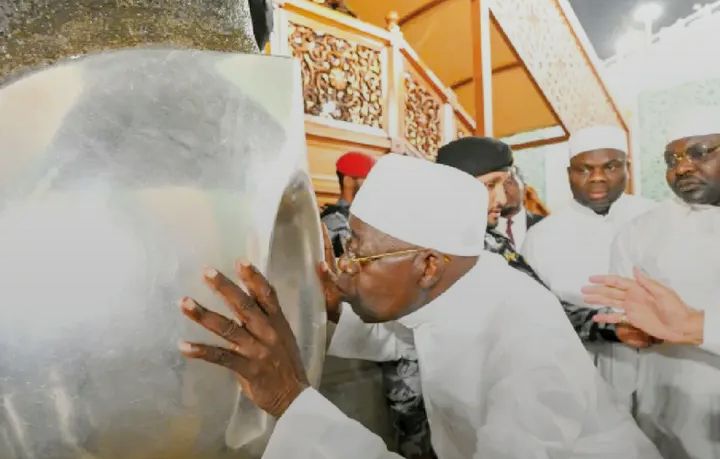
President Bola Tinubu has returned to Abuja after completing a week-long lesser pilgrimage, known as Umrah, in Makkah, Saudi Arabia.
The President arrived at the Nnamdi Azikiwe International Airport, Abuja, at 8:53pm on Wednesday aboard the presidential Airbus A330-200, according to a brief update by the State House media office.
He was received at the airport by the Chief of Staff to the President, Femi Gbajabiamila; the Minister of Education; the Minister of State for Defence; the Inspector-General of Police; and other senior government officials.
Tinubu had departed King Abdulaziz International Airport in Jeddah earlier on Wednesday at 5:13pm Saudi time aboard the presidential aircraft.
The presidential visit, which commenced on Thursday last week, was primarily for the performance of Umrah at the Grand Mosque, Masjid al-Haram.His comment came days after he formally flagged off his re-election campaign in Kaduna on October 24, ahead of the January 16, 2027 general elections.
Members of the presidential entourage included the National Security Adviser, Mallam Nuhu Ribadu, and the governors of Sokoto, Jigawa, Kaduna, Borno and Yobe States, among other government officials.
The President’s return marks the end of his week-long religious visit to Saudi Arabia as political activities ahead of the 2027 general elections continue to gather momentum.

Benin’s President, Romuald Wadagni, has reshuffled the country’s military leadership, nearly a year after a failed coup attempt and amid growing security threats in the West African nation.
Wadagni announced the changes on Wednesday, appointing new heads for the army, air force and navy as his administration intensifies efforts to address security challenges facing the country.
The reshuffle comes months after Beninese soldiers loyal to the government foiled an attempt by some military officers to overthrow former President Patrice Talon in December 2025.
France and Nigeria reportedly supported efforts to prevent the coup.
Following the failed plot, Talon had declared that the situation in the country was “completely under control”, crediting loyalist soldiers with helping to protect his administration.
Wadagni, who served as economy minister under Talon for 10 years, succeeded him as president in April 2026.
Under the latest changes, General Abou Issa has been appointed to replace General Fructeux Gbaguidi as Chief of Army Staff.
Gbaguidi will now serve as the permanent secretary of the National Defence and Security Council.
Wadagni also appointed Colonel Andre Dokoui Fofo as head of the land-based military, while Colonel Herve Setondji Allotchenou will lead the air force.
Captain Dossa Hounkpatin was named the new head of the navy.
The military shake-up comes as Benin faces an increasingly difficult security situation, particularly in its northern regions, where jihadist groups affiliated with Al-Qaeda and the Islamic State have intensified activities across the borders with Burkina Faso and Niger.
The worsening security situation is among the major challenges confronting Wadagni, who assumed office in April after spending a decade overseeing the country’s economy.
His administration is also facing diplomatic challenges arising from strained relations with neighbouring Sahel countries, which are currently governed by military juntas.
The juntas have expressed distrust towards Benin over its close relations with France, a development that has complicated regional security cooperation.
The latest military appointments are expected to form part of the government’s efforts to strengthen the country’s defence structure and respond to emerging security threats.
-

 Security4 months ago
NDLEA Declares Alleged Drug Kingpin, Three Associates Wanted, Freezes ₦9.8bn Linked to Syndicate
-

 Business/Finance3 months ago
How to Apply for Tunde Onakoya’s ₦250 Million Scholarship Programme and Free Laptop Offer
-

 National Affairs3 months ago
ICPC Uncovers 908 Suspected Ghost Workers Across 50 Federal MDAs, Recovers ₦942 Million
-

 Judiciary | Public Safety4 months ago
INEC Tells Court Voter Information Is Not Confidential in Emeka Ike’s ₦10bn Lawsuit
-

 Politics3 months ago
Atiku Challenges Tinubu to Reveal Details of ₦15.13bn SUV Procurement in 2026 Budget
-

 Judiciary | Public Safety3 months ago
Court to Rule Friday on NDLEA’s Bid to Destroy ₦480bn Meth Lab in Ogun
-

 Security3 months ago
Family Paid ₦50 Million Ransom to Secure Release of Abducted Kebbi Judge
-

 News3 months ago
2026 Budget: FG Earmarks ₦962.83bn for SUVs, Empowerment Projects Amid Debt Concerns