
2027 Elections
2027: Tinubu, Obi, Atiku Others Sign Peace Accord as INEC Warns Against ‘Total War’ Politics


Presidential candidates and leaders of political parties contesting Nigeria’s 2027 general elections have signed a National Peace Accord, pledging to conduct their campaigns peacefully and reject violence, hate speech, misinformation and other forms of conduct capable of threatening the country’s democratic process.
The accord was signed on Tuesday in Abuja under the auspices of the National Peace Committee (NPC), in collaboration with The Kukah Centre, less than 24 hours before the official commencement of the 2027 electioneering campaign on Wednesday, August 19.
The agreement places renewed focus on the responsibility of political parties, candidates, campaign organisations and their supporters to ensure that competition for political power does not degenerate into violence or deepen Nigeria’s existing ethnic, religious and political divisions.
However, the absence of some of the country’s most prominent presidential candidates, including President Bola Ahmed Tinubu, the All Progressives Congress (APC) candidate, and former Vice President Atiku Abubakar, the African Democratic Congress (ADC) candidate was noticeable at the ceremony.
Tinubu was represented by the Secretary to the Government of the Federation, George Akume, while other presidential candidates, including Peter Obi of the Nigeria Democratic Congress (NDC), Adewole Adebayo of the Social Democratic Party (SDP), and Omoyele Sowore of the African Action Congress (AAC), attended.
The Independent National Electoral Commission (INEC) Chairman, Professor Joash Amupitan, as well as senior representatives of the security establishment, were also present.
The signing of the accord comes at a particularly sensitive moment in Nigeria’s political calendar.
Campaigns for the 2027 elections officially begin on Wednesday, August 19, setting the stage for months of intense political mobilisation ahead of the presidential and National Assembly elections scheduled for January 16, 2027, and the governorship and State House of Assembly elections scheduled for February 6, 2027.
With political parties already engaged in aggressive mobilisation, defections, coalition-building, litigation and the consolidation of electoral structures, concerns have grown over the possibility of political competition escalating into violence.
The National Peace Committee said the agreement was therefore designed to establish clear boundaries for political competition before the campaign season gathers momentum.
The organisers stressed that the accord was not intended to be merely symbolic or ceremonial.
Rather, they said it was anchored on Nigeria’s Constitution, the Electoral Act, INEC regulations and other laws governing the electoral process.
The objective is to ensure that political competition remains within democratic and legal boundaries.
Obi: Nigerians Should Punish Politicians Who Violate Accord
Speaking shortly before signing the agreement, NDC presidential candidate Peter Obi argued that politicians should not need a peace accord to behave responsibly.
For Obi, seeking the highest political offices in the country should come with an obligation to demonstrate exemplary conduct.
He nevertheless urged Nigerians to hold politicians accountable if they breach their commitments.
Asked what punishment should await candidates or parties that violate the accord, Obi gave a direct answer:
“The punishment is that Nigerians should not vote for them.”
He said political leaders must understand that the titles associated with public office require corresponding standards of conduct.
“You can’t answer ‘His Excellency’ without being an excellent person,” Obi said.
He also used the occasion to make another appeal for a credible 2027 election in which voters would have confidence that their ballots would determine the outcome.
“I don’t have any fear going into next year’s election except to say that, please, for the sake of the children of Nigeria, can we have an election where people’s votes will count?” he asked.
The former Anambra State governor also expressed concern over deaths recorded during the recently concluded Osun State governorship election.
According to Obi, political competition should never become a reason for Nigerians to lose their lives.
“We should comfort their families, and we should remain prayerful and conduct ourselves in a way that in our democracy, nobody needs to die for an election,” he said.
‘We Don’t Even Need to Sign This’
Obi went further to question the necessity of signing a peace agreement in the first place.
He argued that politicians who aspire to lead a country should naturally understand the responsibility to conduct themselves peacefully and responsibly.
“We don’t even need to sign this. We’re seeking an office where we should be exemplary,” he said.
Asked whether he still believed in Nigeria’s electoral process despite his concerns, Obi said his participation was driven by the desire to change the system.
“Because I want to change the process, I have to go through it. So, I have to believe in it,” he said.
His remarks capture one of the central challenges facing the 2027 election: political actors are being asked to compete within an electoral system that some of them have repeatedly criticised.
National Peace Committee Warns Against Weaponising Politics
The Project Manager of the National Peace Committee at The Kukah Centre, Asabe Ndaye, said the accord represented a public commitment by political parties and candidates to peaceful competition, democratic accountability, respect for the rule of law and the will of voters.
She said the committee had convened electoral stakeholders in March 2026 and provided legal annotations to the agreement to ensure that political actors understood the obligations and consequences associated with its provisions.
“The Peace Accord is a public commitment by political parties and candidates to peaceful political competition, respect for the rule of law, democratic accountability and the will of the people,” Ndaye said.
She warned that the agreement would be meaningless if politicians signed it publicly but encouraged conduct that violated its principles privately.
The committee specifically expects candidates, party chairmen, campaign spokespersons, officials and supporters to refrain from creating, publishing, disseminating, endorsing or knowingly amplifying fake news and misinformation intended to provoke violence or undermine electoral integrity.
Ndaye said existing laws already provide sanctions for conduct involving violence, intimidation, inflammatory rhetoric and the promotion of ethnic, religious or sectional division.
She said the National Peace Committee had facilitated 31 peace accords since its establishment.
One of the most striking aspects of the committee’s presentation was its assessment of violations recorded during the 2023 electoral cycle.
Ndaye disclosed that 43 per cent of recorded breaches of the previous peace accord were connected to the commitment to issue-based campaigns.
Another 13.5 per cent involved provisions against insults and violence, while nine per cent related to fake news and disinformation.
The figures highlight the gap between the commitments political actors make before elections and their conduct once campaigns become more competitive.
Ndaye said 58 per cent of violations relating to issue-based campaigns were attributed to party spokespersons, with 22 states affected.
Among the states identified were Kaduna, Plateau, Kano, Lagos, Rivers and Benue.
The warning is particularly relevant ahead of the 2027 campaign, where social media, artificial intelligence-generated content and highly organised online political networks are expected to play an even greater role.
“Political language is not just communication. In a tense electoral environment, it can actually become a risk signal,” Ndaye warned.
2,510 Security Incidents Recorded
The National Peace Committee also disclosed a worrying security picture ahead of the 2027 elections.
According to Ndaye, the committee’s Election Security Information (ESI) Hub recorded 2,510 security incidents between June 2025 and August 2026.
Zamfara, Borno, Kaduna, Niger, Benue and Plateau were among the states identified as particularly affected by insecurity, including banditry, kidnapping and terrorism.
The ESI Hub also recorded 381 electoral offences during the period.
The Federal Capital Territory, Osun, Oyo and Lagos were among locations where significant electoral incidents were recorded.
The threats identified include:
vote buying;
political violence;
thuggery;
physical attacks;
intimidation;
misinformation;
party conflicts;
electoral malpractice; and
voter suppression.
These figures provide an important warning ahead of the 2027 election: electoral violence rarely begins on election day.
Ndaye said tensions often develop much earlier through disputed party primaries, defections, factional disputes, nomination battles, litigation, inflammatory rhetoric and political realignment.
She urged political parties and candidates to identify and address these tensions before they become violent conflicts.
INEC: ‘Elections Are Not Total Wars’
INEC Chairman Joash Amupitan used the occasion to issue perhaps the clearest warning of the day.
He said elections should not be treated as existential battles in which political opponents are viewed as enemies.
“Electoral contests in a constitutional democracy are not total wars; they are competitive job interviews before the electorate,” Amupitan said.
The INEC chairman urged political parties to turn the 2027 campaign into a “marketplace of ideas”, where candidates explain not only what they intend to do but also how they intend to achieve their objectives.
He expressed concern over the growing use of hate speech, toxic political polarisation, misinformation and personality-driven campaigns.
According to him, political discourse is increasingly moving away from discussions about policy and governance towards character assassination, identity-based mobilisation and inflammatory rhetoric.
He urged candidates to address issues such as economic growth, insecurity, infrastructure, healthcare, education and social inclusion.
Amupitan also disclosed details of INEC’s preparations for the 2027 election.
According to him, the commission is preparing to deploy approximately 1.4 million ad-hoc personnel across more than 176,000 polling units.
He said INEC had spent the past eight months working on technology, logistics and personnel training.
But the commission’s chairman stressed that technological improvements alone could not guarantee credible elections.
Political actors, he said, must also demonstrate responsibility.
“It is not the signatures written on this Accord today that preserve democracy; it is the character of the leaders who hold the pen,” Amupitan said.
That statement goes to the heart of the challenge confronting the peace initiative.
A peace accord can establish expectations, but it cannot by itself prevent violence if political parties and their supporters are unwilling to respect the rules.
The Inspector-General of Police, Tunji Disu, represented at the ceremony by Deputy Inspector-General Umar Shehu, also warned political actors against actions capable of destabilising the electoral environment.
Disu said election security should not be viewed as something that begins on election day.
Rather, he said it is built throughout the electoral cycle through the conduct of political parties, candidates, supporters and security agencies.
He warned against ethnic mobilisation, religious division, intimidation, hatred and violence.
The police chief also cautioned political parties against recruiting armed groups, criminal elements or individuals carrying illegal firearms to intimidate political opponents.
His warning was particularly significant given Nigeria’s history of political thuggery and the use of informal armed groups during elections.
“You cannot publicly preach peace while privately encouraging violence,” he said.
Disu also urged political parties to take responsibility for the conduct of their supporters and campaign organisations.
He called for greater inclusion of women, young people, persons with disabilities and other groups that have traditionally remained underrepresented in Nigerian politics.
Representing President Tinubu, SGF George Akume said the President and the APC were committed to the principles contained in the accord.
Akume commended the National Peace Committee and described peaceful elections as essential to democratic stability.
He pointed to technological developments such as permanent voter cards and biometric voter accreditation as measures that have strengthened election management.
He nevertheless urged political parties to avoid ethnic and religious rhetoric and focus instead on policies capable of improving the lives of Nigerians.
“As the campaign season kicks off, I commit myself and my party, the All Progressives Congress, to the tenets of this accord,” Akume said.
He said the APC rejected violence, hate speech, misinformation, including AI-generated misinformation, and incitement on social media.
Not every opposition candidate was convinced that signing another peace agreement would be sufficient.
SDP presidential candidate Adewole Adebayo questioned the practical value of the accord, arguing that previous agreements had been violated without adequate consequences.
He also raised concerns about the independence and conduct of government institutions, security agencies and INEC.
Adebayo argued that a credible election requires more than promises from politicians.
According to him, government institutions must also operate independently, transparently and in accordance with the law.
His intervention highlights a broader issue: peaceful elections depend not only on whether candidates refrain from violence, but also on whether citizens believe the electoral process itself is fair.
Where political actors believe institutions are biased, tensions can escalate even without direct physical violence.
The recent Osun governorship election also featured prominently in discussions surrounding the accord.
The poll was followed by allegations of violence, political intimidation and attacks involving supporters of rival political parties.
For observers of the 2027 electoral cycle, Osun provides a timely reminder of how quickly political tensions can escalate around a closely contested election.
The National Peace Committee’s decision to highlight early-warning mechanisms is therefore significant.
The committee says it is monitoring developments before they become full-blown crises, including political defections, party disputes, litigation, misinformation and inflammatory political messaging.
That approach could prove crucial as the 2027 contest becomes more intense.
What the Peace Accord Really Means for 2027
The significance of Tuesday’s agreement goes beyond the ceremony itself.
Nigeria has conducted numerous elections in which political actors signed agreements promising peaceful campaigns, only for tensions to escalate later.
The real test of the 2027 accord will therefore not be the signatures captured on camera in Abuja.
It will be whether political parties respect its provisions when the stakes become higher, candidates begin attacking one another, supporters become emotionally invested and allegations of electoral malpractice emerge.
The responsibility also extends beyond presidential candidates.
Party spokespersons, governors, lawmakers, campaign directors, social media influencers and grassroots supporters can all contribute to either escalating or reducing political tensions.
The same applies to security agencies and electoral officials.
A peaceful election requires political neutrality, credible electoral administration, responsible security deployment, accurate information and confidence that legitimate grievances can be resolved through lawful channels.
The 2027 election will be one of the most consequential electoral contests in Nigeria’s recent history.
With political alliances already shifting and major parties preparing for a fiercely contested campaign, the potential for political competition to become confrontational remains high.
The National Peace Committee has now drawn the boundaries.
INEC has issued its warning.
The police have made their expectations clear.
Political parties have signed the document.
The question is whether these commitments will survive the pressures of an increasingly competitive campaign.
Nigeria does not merely need an election without widespread violence. It needs an election in which political opponents can compete fiercely without becoming enemies, voters can make choices without intimidation, and losing candidates can pursue legitimate legal remedies without calling their supporters to the streets.
The ultimate measure of Tuesday’s Peace Accord, therefore, will come not in Abuja but across Nigeria’s communities, polling units and political spaces in the months ahead.
The signatures have been made. The real test begins with the campaign.



The Obi-Kwankwaso Movement has unveiled a 59-member Presidential Campaign Council as part of its preparations to mobilise support for the proposed joint presidential ticket of Peter Obi and Rabiu Kwankwaso ahead of the 2027 general elections.
The campaign council, announced on Thursday, comprises zonal and state coordinators as well as directors overseeing mobilisation, women affairs, strategy and planning, security and intelligence, legal affairs, information technology, administration and other areas.
The Director-General of the movement, John Ughulu, was named Director-General of the campaign, while the National Secretary, Saadatu Sani, is also part of the campaign leadership.
The structure covers Nigeria’s six geopolitical zones and the Federal Capital Territory, with coordinators appointed for the 36 states.
In a message congratulating the newly appointed members, Sani described their appointments as a call to duty and urged them to take the message and political agenda of the movement to Nigerians across the country.
She said the council had been entrusted with the responsibility of communicating the vision and aspirations of the movement’s principals to Nigerians from the cities to grassroots communities, including local government areas and wards.
“Your selection is not merely an appointment; it is a call to duty, sacrifice, leadership and service to Nigeria. At this critical moment in our nation’s history, the responsibility before the Presidential Campaign Council is enormous,” Sani said.
She added that the movement’s campaign would focus on what it described as a broader national vision rather than individuals seeking personal recognition.
According to her, the movement aims to mobilise Nigerians around the possibility of a more prosperous, united and functional country.
Sani urged members of the council to approach their responsibilities with discipline, loyalty, humility and commitment to the collective objectives of the movement.
“The road ahead will require hard work. It will require strategic thinking, grassroots mobilisation, effective communication and, above all, the ability to work together as one formidable political family,” she said.
She further stated that the immediate responsibility of the campaign council was to ensure that the message of Obi and Kwankwaso reached voters across the country.
Zonal coordinators named
The movement appointed Suleiman Abubakar as North-Central coordinator, Hashimu Dungurawa as North-West coordinator, and Amadu Gwambe as North-East coordinator.
Dr Adebayo Adefolaseye was named South-West coordinator, Christopher Ighodaro was appointed South-South coordinator, while El-Shaddai Ikeh will coordinate activities in the South-East.
State coordinators were also appointed for the 36 states and the Federal Capital Territory.
Other members of the campaign council include Rev. Mike Agbon, Director of Inter-Ethnic Group in Northern Nigeria;
Sabo Gashua, Director of Grassroots Mobilisation; Glory Adayi, Director of Women Affairs; and Kabir Yahaya, Director of Contact and Engagement.
Abdumumini Tijjani was appointed Director of Mobilisation, Yusuf Mani as Director of Special Duties, Peace Daful as Director of Procurement, Prof. Charles Nwekeaku as Director of South Eastern Town Hall, and Sunmisola Adebayo as Director of Information Technology.
Kingdom Okere was appointed Director of Legal Affairs, Abiodun Dabiri as Director of Strategy and Planning, Richard Enemona, a retired Chief Superintendent of Police, as Director of Security and Intelligence, while Aisha Abdulrahaman was named Director of Administration.
The unveiling of the council is the latest move by the group to establish its campaign structure ahead of the 2027 elections.
Last month, the Obi-Kwankwaso Movement reaffirmed its decision to maintain an independent organisational structure rather than merge with another political organisation.
It also backed Ughulu as its founder and Director-General.
The movement had also recently condemned what it described as the disruption of Obi’s convoy during his visit to Benue State.
The group called for an impartial investigation into the incident and said its security personnel exercised restraint to prevent the situation from escalating.
The 59-member campaign council is expected to coordinate the movement’s mobilisation and engagement activities across the country as political activities ahead of the 2027 general elections continue to intensify.


The Independent National Electoral Commission has commenced strategic engagement with the Joint National Association of Persons with Disabilities and Organisations of Persons with Disabilities as part of efforts to increase the participation of persons with disabilities in the 2027 general elections.
The engagement, which also involved cluster heads, focused on sensitisation and mobilisation of persons with disabilities to ensure that eligible voters are adequately informed, effectively reached and meaningfully involved at every stage of the electoral process.
The initiative comes as preparations for the 2027 general elections gather momentum, with the electoral commission seeking greater inclusivity and accessibility for all eligible voters.
In a post on its X handle on Wednesday, the Acting Chairman of INEC, Prof. Rhoda Gumus, who represented the Commission’s Chairman, Prof. Joash Amupitan, SAN, said the engagement was timely.
Gumus said INEC was committed to building an electoral process that would be inclusive, accessible, participatory and responsive to the needs of all eligible citizens.
“The Commission is committed to building an electoral process that is inclusive, accessible, participatory and responsive to the needs of all eligible citizens,” she said.
She noted that the participation of persons with disabilities in elections was backed by relevant legal and policy frameworks.
These include Section 54 of the Electoral Act 2026, the Discrimination Against Persons with Disabilities (Prohibition) Act 2018 and INEC’s Framework on Access and Participation of Persons with Disabilities in the Electoral Process.
The Acting Chairman, however, stressed the need for innovative approaches to voter education to ensure that electoral information reaches persons with different forms of disabilities.
“We must explore innovative approaches to voter education, including disability-specific communication channels, community-based organisations, radio, social media and other assistive formats,” Gumus said.
INEC releases disability voter data
The Commission disclosed that its available data, compiled before the introduction of the Automated Fingerprint Identification System, recorded 137,487 persons with disabilities.
According to INEC, the figure comprises 13,080 visually impaired persons, 9,299 hearing-impaired persons, 30,561 persons with albinism, 19,430 persons with physical impairments and 54,941 persons under other disability categories.
The Commission’s engagement with disability organisations is expected to help bridge information gaps and address challenges that could prevent eligible persons with disabilities from participating effectively in the electoral process.
Gumus urged JONAPWD and the various Organisations of Persons with Disabilities to take ownership of the sensitisation campaign by reaching their members across different disability clusters.
She said members should receive timely and accurate information about voter registration, Permanent Voter Card collection, voting procedures, accessibility measures and other aspects of the electoral process.
“I urge JONAPWD and the Organisations of Persons with Disabilities to take ownership of this sensitisation process and ensure that members within your respective clusters receive timely and accurate information,” she said.
Stakeholders to identify barriers before 2027 polls
According to Gumus, the engagement also provides an opportunity for stakeholders to identify barriers that could affect the participation of persons with disabilities before, during and after the 2027 elections.
She said stakeholders would be able to share successful strategies and agree on practical measures to improve the experience of persons with disabilities throughout the electoral process.
“This engagement provides an opportunity to identify barriers to participation, share successful strategies and agree on practical actions that can be implemented before, during and after the elections,” Gumus said.
The Director of Gender and Inclusivity at INEC, Mrs Lakunuya Dorothy Bello, also highlighted some measures already introduced by the Commission to improve accessibility for voters with disabilities.
Among the measures are Braille ballot guides, magnifying glasses, the EC30 PWD form and sign-language interpretation during collation activities.
The Commission said the latest engagement forms part of its broader efforts to ensure that persons with disabilities are adequately informed and able to participate fully in the electoral process.
INEC said continued collaboration with JONAPWD, OPDs and other relevant stakeholders would be important in identifying practical solutions to accessibility challenges ahead of the 2027 general elections.
2027 Elections
2027: APC Governors Reject Parallel Structures as Wike’s Rainbow Coalition Tests Tinubu’s Political Alliance

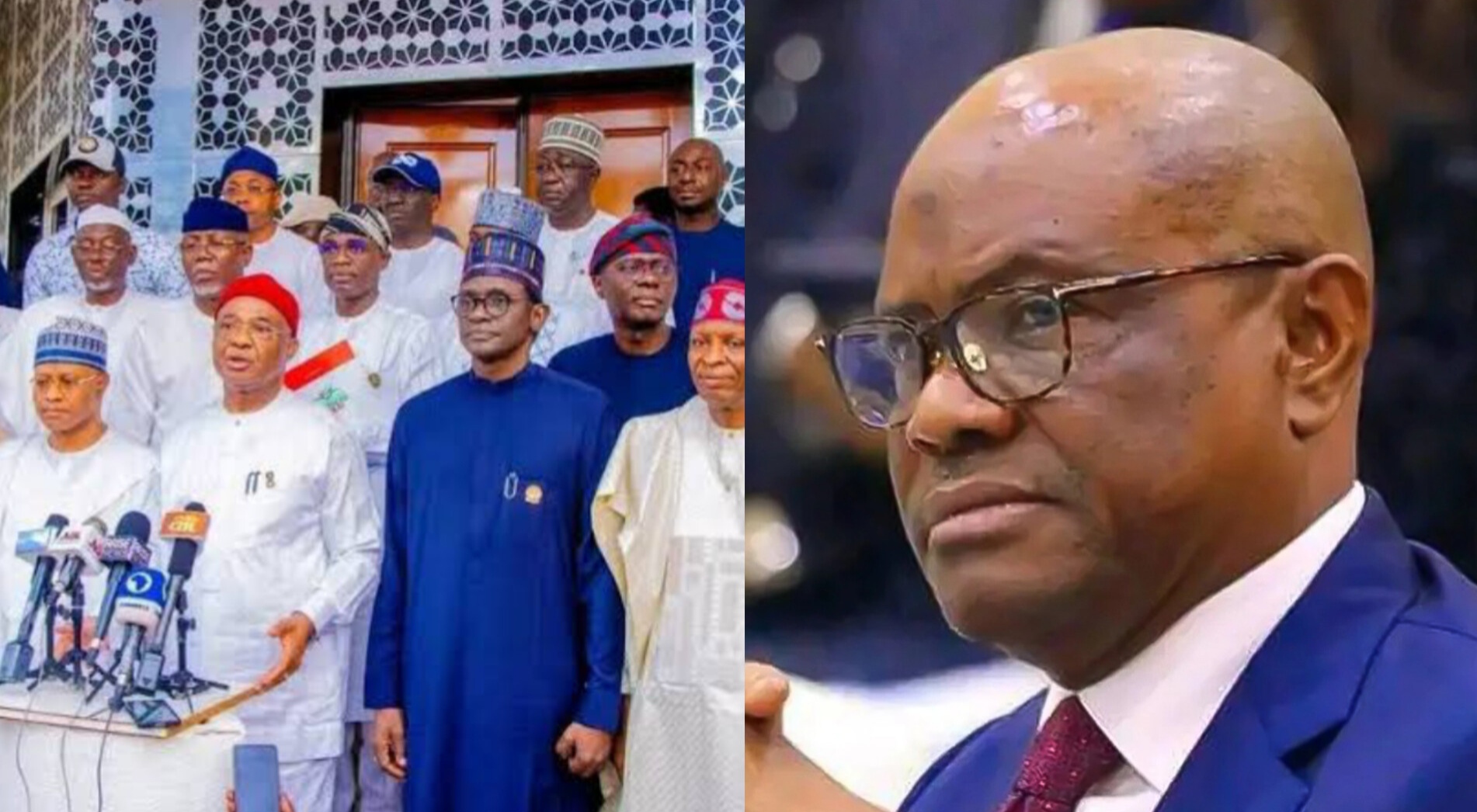
The All Progressives Congress (APC) Governors’ Forum has rejected political alliances and parallel structures that could weaken the ruling party or undermine President Bola Ahmed Tinubu’s re-election bid in the 2027 general elections.
The governors said they would not support candidates outside the APC or participate in political arrangements capable of creating divided loyalty within the party.
The position was reached at a closed-door meeting of APC governors in Abuja on Monday night and announced by the Chairman of the Progressive Governors Forum and Imo State Governor, Hope Uzodimma.
The declaration comes amid growing political tension surrounding the Rainbow Coalition associated with Minister of the Federal Capital Territory, Nyesom Wike, who remains a member of the Peoples Democratic Party (PDP) while serving in the APC-led Federal Government.
Wike has maintained that his political coalition is primarily designed to support Tinubu’s re-election in 2027.
However, the emergence of candidates and political interests operating across different party platforms has generated concern among APC governors that the arrangement could weaken the party’s candidates in governorship, National Assembly and state assembly contests.
Reading the communiqué after the meeting, Uzodimma said APC governors would remain committed to candidates officially sponsored by the party.
“The APC Governors Forum unanimously resolved that its members will not participate in, support or endorse any alliance or political arrangement capable of undermining the re-election of Mr President, weakening the APC or adversely affecting any candidate of the party at all levels,” he said.
The Imo governor added that the governors had no intention of supporting candidates who were not running on the APC platform.
He said the governors’ campaign commitment would be exclusively directed towards APC candidates, with the party’s campaign structure expected to align with Tinubu’s re-election strategy and the broader objectives of the APC.
The declaration effectively establishes a position that APC governors will not treat support for Tinubu at the presidential level as a licence to support rival candidates in other elections.
The development places Wike’s political project at the centre of an increasingly complicated calculation within the ruling party.
Wike has promoted a broad political coalition bringing together politicians across party lines while maintaining support for Tinubu’s presidential ambition.
That strategy creates a potential distinction between support for Tinubu and support for APC candidates.
For the APC governors, the concern is that a political structure capable of mobilising voters for Tinubu while simultaneously supporting candidates from other parties could weaken the ruling party’s candidates in the same election cycle.
Reports have identified growing political tensions associated with the coalition in states including Rivers, Kwara, Gombe and Cross River.
The governors’ objection is therefore not simply about whether Wike supports Tinubu. It is also about who controls the political machinery through which votes are mobilised and which candidates ultimately benefit from that machinery.
The split-ticket voting concern
At the heart of the disagreement is the possibility of split-ticket voting.
Under such an arrangement, a voter could support Tinubu for president while voting for a candidate from another party in a governorship or legislative contest.
For Wike and his allies, such an arrangement can be presented as a way of building a broad coalition around the presidency without requiring every participant to join the APC.
For APC governors, however, it creates a direct threat to the party’s candidates.
The governors’ latest resolution suggests that they want the 2027 campaign architecture to operate as a unified structure, rather than one in which different political blocs mobilise voters for different candidates.
Wike and APC governors already at odds
The latest development also follows increasingly public disagreements between Wike and some APC governors.
Wike recently alleged that Uzodimma and Kwara State Governor AbdulRahman AbdulRazaq were behind political opposition to his activities.
According to reports, Wike linked the resistance to the expansion of his Rainbow Coalition and its growing influence among politicians seeking electoral opportunities outside the APC.
The governors’ latest resolution did not name Wike or the Rainbow Coalition directly. Nevertheless, the timing and content of the declaration have been widely interpreted as a response to the political arrangement associated with the FCT minister.
A test of Tinubu’s 2027 coalition strategy
The disagreement presents an important political challenge for the Tinubu camp.
The President’s re-election strategy could benefit from support beyond the formal APC structure, particularly from influential politicians who remain members of opposition parties but are willing to support his presidential bid.
At the same time, APC governors have their own electoral interests. Their political survival depends not only on the President’s performance at the presidential level but also on the success of APC candidates seeking governorship, Senate, House of Representatives and state assembly seats.
That creates a potentially delicate balance between Tinubu’s national coalition-building strategy and the APC’s institutional interest in protecting its candidates at every level.
For Wike, the challenge is equally significant. His continued influence within the Tinubu administration gives him access to national political space, but his decision to remain in the PDP while promoting a cross-party coalition places him outside the formal structure of the ruling party.
The governors’ resolution shows that they are increasingly unwilling to allow that distinction to translate into competing political structures within states controlled by the APC.
The immediate question is whether the governors’ position will remain a political warning or develop into a broader confrontation over the structure of the 2027 campaign.
Wike has consistently argued that his political activities are intended to strengthen Tinubu’s chances. The APC governors, however, are insisting that support for the President must not come at the expense of the party’s candidates.
That difference could become increasingly important as the 2027 election approaches and parties begin finalising candidates, alliances and campaign structures.
For now, the APC governors have made their position clear: Tinubu’s re-election and the electoral fortunes of APC candidates must not be separated in a way that creates competing political loyalties within the ruling party.
The emerging contest, therefore, may be less about whether Wike supports Tinubu and more about who controls the political machinery that will determine how that support translates into votes in 2027.
-
 Security2 months ago
NDLEA Declares Alleged Drug Kingpin, Three Associates Wanted, Freezes ₦9.8bn Linked to Syndicate
-

 National Affairs2 months ago
ICPC Uncovers 908 Suspected Ghost Workers Across 50 Federal MDAs, Recovers ₦942 Million
-

 Business/Finance2 months ago
How to Apply for Tunde Onakoya’s ₦250 Million Scholarship Programme and Free Laptop Offer
-
 Politics2 months ago
Atiku Challenges Tinubu to Reveal Details of ₦15.13bn SUV Procurement in 2026 Budget
-

 Judiciary | Public Safety2 months ago
INEC Tells Court Voter Information Is Not Confidential in Emeka Ike’s ₦10bn Lawsuit
-
 Judiciary | Public Safety2 months ago
Court to Rule Friday on NDLEA’s Bid to Destroy ₦480bn Meth Lab in Ogun
-
 Security1 month ago
Family Paid ₦50 Million Ransom to Secure Release of Abducted Kebbi Judge
-

 Breaking News2 months ago
Girl Dies in Uyo House Fire After Allegedly Accompanying Man Home from Nightclub