
Editorial
Three Years After Fuel Subsidy Removal: Can the Average Nigerian See the Benefits?


When President Bola Ahmed Tinubu announced on May 29, 2023, that “fuel subsidy is gone,” the declaration immediately changed the economics of everyday life in Nigeria.
Petrol became more expensive. Transport fares rose. Businesses that depended on petrol and diesel faced higher operating costs. Food distribution became more expensive. Households began adjusting how often they travelled, what they bought and how they spent their income.
Three years later, the government says the painful decision was necessary and that it has produced substantial fiscal benefits.
But there is another question that cannot be answered with government revenue figures alone:
Can the ordinary Nigerian actually see the benefit of fuel subsidy removal?
The answer, based on available evidence, is far from straightforward.
The Government’s Case: N15.8 Trillion Released
The Federal Government’s latest Reform Scorecard says the removal of petrol subsidy mobilised N15.8 trillion for the Federation between June 2023 and December 2025.
The government says N5.43 trillion accrued to the Federal Government, N6.52 trillion went to states and N3.88 trillion to local governments.
But there is an important qualification.
The N15.8 trillion is not N15.8 trillion sitting somewhere in Abuja waiting to be spent on projects.
The Finance Ministry itself now describes the figure as a financing story rather than a simple savings account. The money was distributed through the Federation Account, while the Federal Government’s own incremental resources also included other revenues and borrowing.
The Federal Government says the reforms created fiscal space for infrastructure, wages, social programmes and other obligations.
That is a legitimate argument.
But it is only half of the story.
The other half is what happened to the purchasing power of the people who actually financed the adjustment through higher fuel and transport costs.
Ask the Commuter
For the average Nigerian, the subsidy debate is not primarily about Federation Account allocations.
It is about getting to work.
It is about taking children to school.
It is about transporting goods to the market.
It is about whether a trader can afford to travel to buy stock.
It is about whether a salary that once covered a family’s monthly expenses still does so.
And on these measures, the evidence remains troubling.
A recent Reuters report found that Nigeria’s reforms have helped improve investor confidence and public finances but have simultaneously produced severe cost-of-living pressures, with ordinary Nigerians still struggling with food and fuel costs.
That contradiction is at the heart of Nigeria’s subsidy debate.
The economy can improve at the macroeconomic level while households continue to feel poorer.
Both things can be true at the same time.
What Nigerians Have Actually Said
There is perhaps no more important evidence than what Nigerians themselves say about the policy.
An Afrobarometer survey found that 85 per cent of Nigerians disapproved of the government’s decision to remove fuel subsidies. The survey also found that 74 per cent reported poor personal living conditions, while 88 per cent described the country’s economic condition as fairly bad or very bad.
That finding is significant.
It does not prove that subsidy removal alone caused Nigerians’ economic difficulties. Inflation, naira depreciation, food prices, electricity costs, insecurity and other factors have all contributed.
But it demonstrates something policymakers cannot ignore:
A very large proportion of Nigerians do not currently experience the reform as an improvement in their welfare.
That perception matters.
The Cost Is Not Paid at the Filling Station Alone
One of the biggest problems with the subsidy debate is that it can make petrol appear to be an isolated commodity.
It is not.
Fuel is an input into transportation.
Transportation is an input into food distribution.
Transportation is an input into manufacturing.
Transportation is an input into virtually every commercial activity in the country.
When the cost of moving goods rises, somebody eventually pays.
The consumer usually does.
Research published in 2026 on fuel subsidy removal in Ile-Ife found significant socioeconomic effects on transportation and household welfare among civil servants, traders and commercial drivers.
Another study involving 1,200 households across Nigeria’s six geopolitical zones found that higher fuel prices were associated with increased transportation expenditure and declining household welfare.
Research on informal markets in Benin City also found a substantial increase in transportation costs after subsidy removal, while traders’ average monthly profits declined by about N40,491.
These are not abstract economic indicators.
They describe what happens when the cost of moving people and goods increases.
What About the N15.8 Trillion?
This is where the debate becomes particularly important.
The government says the resources released by subsidy removal have helped finance wages, infrastructure, social programmes and other public obligations.
That claim should not simply be dismissed.
But neither should it automatically be accepted as proof that Nigerians are better off.
The Federal Government’s own latest figures show that its incremental resources between June 2023 and December 2025 amounted to approximately N20.4 trillion, comprising its share of subsidy savings, additional revenue and borrowing.
Its incremental expenditure pressures, however, amounted to approximately N30.64 trillion.
The Ministry of Finance says the additional spending included wage adjustments, debt-service costs, infrastructure, electricity support and social programmes.
This is an important distinction.
The subsidy savings did not create a giant surplus.
Much of the fiscal space was absorbed by existing and additional obligations.
That does not mean the money was wasted.
It means the public conversation should move beyond the simplistic question of:
“Where is the N15.8 trillion?”
The more accurate question is:
What did the additional fiscal resources prevent, finance or improve — and how much of that improvement has reached ordinary households?
Nigerians Are Asking a Different Question
For government officials, the relevant indicators include revenue, reserves, debt, investment, infrastructure and fiscal deficits.
For a market woman, the calculation may be much simpler.
She may ask:
“How much did I earn today, and how much did I spend getting to the market?”
For a civil servant:
“After transportation, food, rent and school expenses, what remains of my salary?”
For a commercial driver:
“After buying fuel, maintaining my vehicle and paying other expenses, how much do I take home?”
For a small manufacturer:
“Can I still produce at a price customers can afford?”
Those questions are not captured by a rising stock market.
The Investor and the Commuter Can Have Different Experiences
There is another uncomfortable reality.
Nigeria’s reforms have attracted favourable attention from investors and international financial institutions.
The naira and foreign-exchange reforms, together with subsidy removal, have helped address long-standing distortions and improve some macroeconomic indicators.
The IMF has also acknowledged the importance of the reforms, although it noted that estimated fuel-subsidy savings did not appear to have accrued fully to the budget in 2025 and that other fiscal pressures remained.
The World Bank has similarly acknowledged improvements in macroeconomic stability while warning that the real measure of success must ultimately be whether those improvements translate into better daily lives for poor and vulnerable Nigerians.
That distinction is crucial.
A country can become fiscally healthier without every household becoming financially healthier at the same time.
Has the Government Failed?
That conclusion would be premature.
The evidence does not support saying that subsidy removal has produced no benefit whatsoever.
There are measurable fiscal changes.
States and local governments have received larger allocations.
The government has financed wage adjustments and social programmes.
Infrastructure spending has increased in some areas.
Nigeria’s macroeconomic position has also changed in important respects.
But there is equally insufficient evidence to say that the benefits have already translated into a broad improvement in household welfare.
That is where the government’s argument remains vulnerable.
The Missing Link: The Dividend of Reform
The biggest problem may therefore not be subsidy removal itself.
It may be the speed and visibility with which the dividends of reform are reaching citizens.
The World Bank has made essentially the same point: macroeconomic stability is not enough; the reforms must eventually improve the daily lives of Nigerians, particularly poor and vulnerable households.
A road project may eventually reduce transportation costs.
A functioning railway may eventually lower freight costs.
Improved electricity may eventually reduce dependence on petrol and diesel generators.
Expanded domestic refining may eventually improve fuel security.
Better public transportation may eventually reduce the burden on commuters.
But Nigerians cannot spend future benefits today.
That is the political and economic challenge facing the government.
And This Is Where the Subsidy Debate Becomes Difficult
Those calling for the return of subsidy have a powerful argument:
People are suffering now.
Those opposing a return to subsidy have an equally serious argument:
Nigeria cannot indefinitely spend billions subsidising consumption while neglecting the productive foundations of the economy.
Both arguments contain elements of truth.
The old subsidy system was expensive and vulnerable to abuse.
But removing it without delivering sufficiently strong alternatives has transferred a substantial portion of the adjustment burden directly to households.
That is why the question should perhaps no longer be framed simply as:
“Should subsidy return?”
The more useful question is:
“How can Nigeria ensure that the benefits of subsidy removal reach Nigerians faster than the pain of the reform?”
What Do Nigerians Want Instead?
The evidence suggests that Nigerians are not necessarily demanding that government simply maintain artificially cheap petrol forever.
Many are demanding something more fundamental: value for the sacrifice they have already made.
That means reliable electricity.
Affordable and efficient public transportation.
Better roads.
Lower food-distribution costs.
Jobs that pay enough to absorb economic shocks.
Effective social protection.
Affordable credit.
Greater accountability for public expenditure.
And, perhaps most importantly, evidence that additional government revenue is actually improving public services.
The government’s latest scorecard is therefore only the beginning of the accountability conversation.
The next stage should be to follow the money from Abuja to the states, from the states to local governments, and from government budgets to actual projects.
If a state received additional revenue because subsidy was removed, Nigerians should be able to see what that additional revenue produced.
If government says billions went into infrastructure, citizens should be able to identify the infrastructure.
If billions went into social protection, Nigerians should be able to establish who benefited.
If government claims that the reform prevented an economic collapse, the evidence should be made accessible enough for independent experts and citizens to test the claim.
The Verdict Is Not Yet In
Three years after the removal of petrol subsidy, it would be dishonest to describe the policy as either an unqualified success or an unqualified failure.
The fiscal case for removing the subsidy is real.
The hardship experienced by Nigerians is also real.
The two facts do not cancel each other.
The government has gained fiscal space, but households have lost purchasing power.
States have received more money, but Nigerians continue to demand better public services.
Investors may see a more credible macroeconomic environment, while workers and traders continue to struggle with the cost of living.
And the government may be correct that returning to the old subsidy system would recreate serious fiscal problems.
But that argument will not be enough to persuade the average Nigerian.
For the ordinary citizen, the ultimate test is much simpler:
“Am I better off?”
At present, the available evidence suggests that many Nigerians would answer no.
That does not necessarily mean the reform should be reversed.
It means the government now has to demonstrate, in ways ordinary Nigerians can see and measure, what the sacrifice has bought them.
Because economic reform is not ultimately successful because a government can produce a spreadsheet showing improved revenue.
It succeeds when the person who paid the price for the reform can eventually feel the benefit.
And for millions of Nigerians, that part of the story is still waiting to be written.





News reporting in Nigeria’s South-East is increasingly taking place within a deeply polarised information environment shaped by insecurity, separatist agitation, political distrust and competing narratives about the role of government and security agencies.
Across Ebonyi, Enugu, Anambra, Imo and Abia states, traditional media, local digital platforms and overseas-based information actors play significant roles in shaping public perception of security operations, violence, civil obedience and government policies.
At the centre of the polarisation are three major issues: separatist agitation, conflicting narratives around insecurity and a growing disconnect between grassroots realities and information circulating online.
Digital platforms have become particularly influential in spreading pro-Biafra narratives and mobilising public action.
Social media channels and online broadcasts have, at various times, been used to issue stay-at-home directives and influence compliance within communities.
The reporting of violence, kidnappings and military operations also frequently differs sharply depending on the source.
While official statements tend to present security operations as efforts to combat criminality, insurgency and other threats, alternative narratives often focus on alleged marginalisation, human rights concerns and perceived heavy-handed tactics by security agencies.
This divergence has created an information environment in which audiences can receive radically different interpretations of the same event.
Another major concern is the widening gap between realities experienced by communities and narratives promoted by digital influencers operating outside the region or from abroad.
In some cases, highly partisan online commentary can overshadow verified accounts from people living in affected communities.
The consequences are significant. Polarised reporting can weaken public trust, accelerate misinformation and expose journalists working on sensitive security and political assignments to increased risks.
Mainstream media organisations are often caught between competing pressures, including state influence, threats from non-state actors, editorial caution and the demand for sensational content capable of generating online engagement.
Social media has further complicated the situation by rewarding emotionally charged narratives.
Content that appeals to ethnic grievances, political divisions or ideological loyalties can spread faster than carefully verified and nuanced reports.
For journalists, this environment creates serious professional and security challenges.
Reporters covering separatist activities, political tensions, violence and security operations may face intimidation or threats from different sides, making independent and comprehensive field reporting increasingly difficult.
The Role of Civil Society
Civil society organisations have an important role to play in confronting the negative effects of media polarisation in the South-East.
For decades, CSOs have served as intermediaries between citizens and government, advocating for democracy, human rights, accountability and social development.
They have also provided platforms for marginalised groups and pushed for greater transparency in governance.
However, civil society itself is not immune to the divisions affecting the wider society.
Competition for resources, ideological differences and generational gaps can create internal fractures that weaken collective advocacy.
If these divisions remain unresolved, they could undermine the capacity of civil society organisations to fulfil their role as defenders of democratic values and social change.
A recent study by Thoughts and Mace Advisory, in partnership with SBM Intelligence and with support from Ford Foundation Nigeria, examined the extent, causes and consequences of polarisation within Nigeria’s civil society sector.
The study reflects growing concern that the divisions affecting Nigerian society are also increasingly visible within the civic space.
Researchers conducted polling involving 134 civil society organisation leaders and 908 beneficiaries, alongside stakeholder consultations in Lagos and Abuja.
The findings provide insights into the factors driving division within the sector and identify possible measures for strengthening unity and protecting Nigeria’s democratic and civic space.
In the South-East, these interventions are particularly important.
Civil society organisations can serve as critical counterweights to misinformation, political propaganda and ethno-regional tensions by promoting fact-checking, digital literacy, inclusive dialogue and transparent public policy.
The challenge, therefore, is not simply about correcting false information. It is about rebuilding trust between communities, journalists, government institutions and civil society.
For journalism in the South-East to thrive, reporters must be able to operate safely, access reliable information and engage communities beyond partisan narratives.
At the same time, audiences need stronger media literacy skills to distinguish verified journalism from propaganda, misinformation and politically motivated content.
Ultimately, reducing polarisation will require a collective effort involving journalists, civil society organisations, government institutions, community leaders and citizens.
A healthier information environment is essential not only for credible journalism but also for social cohesion, accountability and the protection of democratic space in the South-East.
The news that Ariwera Jonathan, son of former President Goodluck Jonathan, has graduated from Manchester Metropolitan University in the United Kingdom is, on its own, a personal achievement deserving of congratulations.
Education should always be celebrated, wherever it is obtained.
Yet, beyond the applause lies a familiar question that resurfaces almost every year whenever the children of Nigeria’s political leaders graduate from universities abroad:
Why do those entrusted with improving Nigeria’s education system so often choose to educate their own children elsewhere?
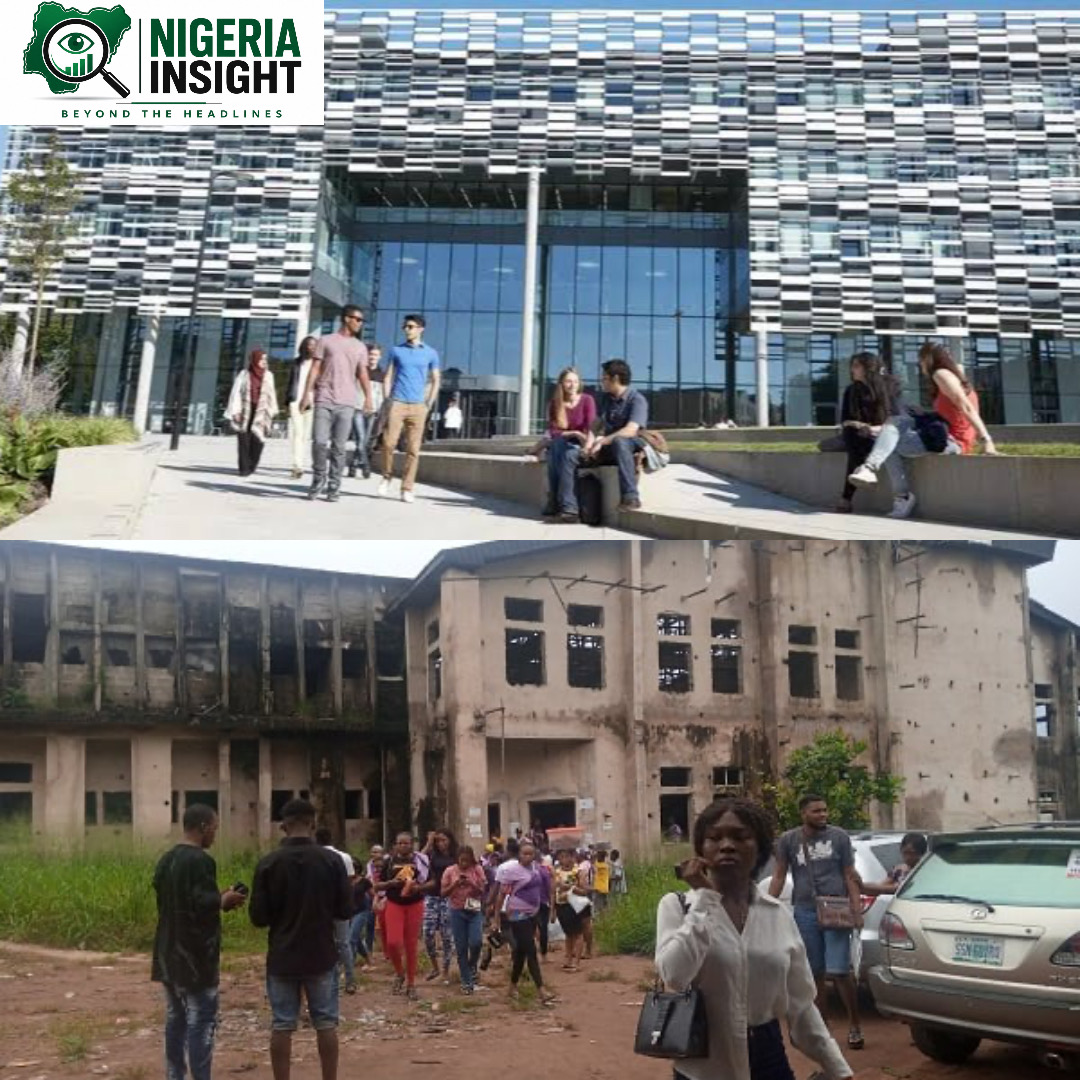
It is a question that transcends political parties and administrations. From presidents and governors to ministers, lawmakers and senior public officials, a significant number of Nigeria’s political elite continue to send their children to universities in the United Kingdom, the United States, Canada and other countries, while public universities at home struggle with inadequate funding, ageing infrastructure, academic disruptions and declining global competitiveness.
This is not about one family.
It is about a national pattern.
For decades, successive governments have promised to reform education. Every administration has spoken about building world-class universities, improving research, modernising laboratories and creating an environment where Nigerian students can compete globally.
Yet the reality confronting many students tells a different story.
Lecture halls remain overcrowded. Laboratories are outdated. Student hostels are overstretched. Industrial actions have repeatedly disrupted academic calendars, leaving thousands of students uncertain about when they will graduate.
Many institutions continue to battle shortages of teaching staff, unreliable electricity, poor internet connectivity and insufficient research funding.
Ironically, many of the foreign universities patronised by Nigeria’s elite benefit financially from Nigerian families.
Billions of naira leave the country each year in tuition fees, accommodation costs and living expenses, effectively exporting resources that could help strengthen domestic institutions if invested wisely.
The issue is not that studying abroad is wrong.
Indeed, exposure to international education can broaden perspectives, encourage innovation and foster global collaboration.
Parents naturally seek what they believe is the best education for their children, and political leaders are no exception.
The real concern is the contrast between private choices and public responsibility.
When public officials express confidence in the policies they implement, citizens expect to see that confidence reflected in their actions.
If those responsible for shaping Nigeria’s education system consistently prefer foreign institutions for their own families, many Nigerians understandably ask whether this signals a lack of faith in the system they oversee.
Public confidence is built not only through speeches and policy documents but also through example.
Imagine the message it would send if more senior public officials proudly enrolled their children in Nigerian universities because they genuinely believed those institutions offered education comparable to the world’s best.
Such confidence could inspire renewed public trust and encourage greater investment in local institutions.
The challenge before Nigeria is not merely to discourage foreign education but to make it a matter of choice rather than necessity.
That requires sustained investment in infrastructure, competitive remuneration for lecturers, modern research facilities, curriculum reforms, stronger university governance and stable academic calendars.
It also demands accountability for education budgets and long-term policies that extend beyond electoral cycles.
Countries that now attract international students did not achieve that status overnight. They invested consistently in knowledge, innovation and academic excellence over many decades.
Nigeria possesses talented academics, brilliant students and universities with enormous potential. What has often been lacking is the political will to provide sustained support and reform.
As Nigerians celebrate another graduate succeeding on the global stage, perhaps the greater national conversation should not be where our leaders’ children study, but why millions of Nigerian parents still feel that quality education is easier to find outside their own country than within it.
Until that question is answered with meaningful reforms rather than recurring promises, stories of Nigerian leaders celebrating foreign degrees will continue to provoke admiration and uncomfortable reflection.
Editorial
Welcome to Nigeria Insight: A New Voice for Truth, Accountability and National Conversation

For every nation, there comes a time when the quality of public conversation becomes as important as the quality of leadership itself.
In an era where information travels faster than verification, where opinions often overshadow facts, and where sensational headlines frequently drown out thoughtful analysis, the need for credible, independent journalism has never been greater.
Today, we are proud to introduce Nigeria Insight.
Nigeria Insight is more than a digital news platform. It is a commitment, a commitment to journalism rooted in truth, fairness, independence, and the public interest.
We are founded on the belief that citizens deserve more than breaking news; they deserve context, clarity, and insight. Our responsibility is not only to report what happens, but to explain why it matters and what it means for the future of our nation.
Nigeria stands at a defining moment in its history. The country continues to confront complex questions about governance, economic reform, security, democratic institutions, social cohesion, and national development.
These issues cannot be understood through headlines alone. They demand careful reporting, rigorous analysis, and informed public debate.
That is the purpose of Nigeria Insight.
Our newsroom will cover politics, governance, elections, public policy, the economy, security, justice, and civic affairs with professionalism and editorial discipline.
We will pursue stories that hold public institutions accountable, examine policies that affect ordinary Nigerians, and provide balanced reporting that helps readers distinguish fact from speculation.
Independence is at the heart of our work. Nigeria Insight is not affiliated with any political party, government, religious organisation, ethnic interest, or commercial group.
Our editorial decisions will be guided solely by evidence, fairness, and the public interest. We believe journalism must remain free from undue influence if it is to earn and keep the trust of its audience.
We also recognise that journalism carries responsibilities as well as rights. Every report published by Nigeria Insight will be held to the highest standards of verification, accuracy, and ethical conduct.
Where mistakes occur, we will acknowledge and correct them transparently. Where opinions are expressed, they will be clearly identified as such. Where allegations are made, fairness will require that all affected parties have an opportunity to respond.
Our commitment extends beyond reporting events. We seek to foster a national conversation that is informed rather than inflammatory, inclusive rather than divisive, and constructive rather than cynical.
Nigeria’s diversity is one of its greatest strengths, and our coverage will reflect voices from every region, profession, generation, and community, including Nigerians living across the world.
To our readers, we make this promise: Nigeria Insight will never knowingly sacrifice accuracy for speed, truth for popularity, or integrity for influence.
We understand that trust is earned article by article, headline by headline, and day by day. That trust will remain our most valuable asset.
As we embark on this journey, we invite you to become active participants in building a more informed society. Read our reports with a critical mind.
Share your perspectives respectfully. Challenge us when we fall short. Hold public institutions accountable, and hold us to the same standard.
The future of Nigeria will be shaped not only by those who govern, but also by citizens who are informed, engaged, and willing to participate in democratic life. Journalism has an indispensable role to play in that process.
Nigeria Insight is honoured to begin that work today.
This is only the beginning.
Welcome to Nigeria Insight.
Beyond the Headlines.
-

 Security2 months ago
NDLEA Declares Alleged Drug Kingpin, Three Associates Wanted, Freezes ₦9.8bn Linked to Syndicate
-
 National Affairs2 months ago
ICPC Uncovers 908 Suspected Ghost Workers Across 50 Federal MDAs, Recovers ₦942 Million
-

 Business/Finance2 months ago
How to Apply for Tunde Onakoya’s ₦250 Million Scholarship Programme and Free Laptop Offer
-
 Politics2 months ago
Atiku Challenges Tinubu to Reveal Details of ₦15.13bn SUV Procurement in 2026 Budget
-

 Judiciary | Public Safety2 months ago
INEC Tells Court Voter Information Is Not Confidential in Emeka Ike’s ₦10bn Lawsuit
-
 Judiciary | Public Safety2 months ago
Court to Rule Friday on NDLEA’s Bid to Destroy ₦480bn Meth Lab in Ogun
-

 Breaking News2 months ago
Girl Dies in Uyo House Fire After Allegedly Accompanying Man Home from Nightclub
-
 Security1 month ago
Family Paid ₦50 Million Ransom to Secure Release of Abducted Kebbi Judge