
News
Stop Killings in Northern Nigeria, Reps Minority Caucus Urges Tinubu


The Minority Caucus of the House of Representatives has called on President Bola Tinubu to take urgent and decisive action to end the worsening wave of terrorism, banditry, killings and mass abductions across Northern Nigeria.
The lawmakers said the escalating attacks on communities had reached an unacceptable level, warning that the continued loss of lives and displacement of residents were worsening insecurity and creating a growing sense of helplessness among affected communities.
In a statement issued on Thursday, the caucus leader, Fredrick Agbedi, and spokesman, Afam Ogene, urged the Federal Government to launch sustained, intelligence-led military and security operations aimed at reclaiming territories occupied or controlled by terrorists and criminal groups.
The lawmakers referenced recent attacks in Plateau, Niger, Sokoto, Kaduna and Katsina states, where scores of residents were reportedly killed or abducted.
According to the caucus, at least 23 people were killed in recent attacks in Mangu Local Government Area of Plateau State.
It also cited an attack in Borgu Local Government Area of Niger State, where armed men reportedly abducted more than 60 worshippers during Friday prayers.
In Sokoto State, the lawmakers said at least 40 people were killed in Ungushi community, Kebbe Local Government Area, including the Chief Imam, Imam Aliyu.
The caucus further reported that about 30 people were killed when gunmen attacked Naridon village in Kaura Local Government Area of Kaduna State.
It said recurring attacks and reprisal killings in Katsina State had also heightened fear among residents, while expressing concern over schoolchildren abducted in Borno State who have remained missing for months.
The lawmakers argued that the security crisis could no longer be addressed mainly through statements condemning attacks after they occur.
They urged President Tinubu to expand and replicate security strategies that have helped rescue abducted schoolchildren and teachers, including the operation that led to the rescue of victims abducted in Oriire Local Government Area of Oyo State.
The caucus called for affected areas to be subjected to intensive security operations, with the military and other security agencies directed to dominate the territory and sustain operations against terrorist and bandit hideouts, forests and criminal enclaves.
The lawmakers stressed that such measures should target the operational space of criminal groups rather than restrict innocent citizens.
“We are calling on the President to lock down the affected theatres of operation, dominate the territory and sweep the forests, hideouts and criminal enclaves where terrorists and bandits operate,” the caucus said.
It added that operations must be intelligence-led, professionally conducted and sustained until criminal groups are defeated and abducted citizens rescued.
The lawmakers also urged President Tinubu to visit Zamfara State and travel to Illela to meet communities affected by insecurity, saying the President’s physical presence could reassure residents and demonstrate the government’s commitment to protecting lives.
Beyond military operations, the caucus called for a significant increase in funding for national security, suggesting that the Federal Government should consider drawing $5 billion from the country’s external reserves if necessary.
It argued that protecting the lives and livelihoods of Nigerians should remain the government’s foremost responsibility.
The caucus also welcomed the recent increase in the salaries of Armed Forces personnel, describing it as an important step towards improving the welfare and morale of military personnel.
However, it urged the President to forward the necessary amendment to the 2026 Appropriation Act and a Supplementary Appropriation Bill to the National Assembly to provide the legal and financial framework for implementing the salary increase.
The lawmakers said the National Assembly should be ready to reconvene, if necessary, to ensure that the welfare measure is implemented without unnecessary bureaucratic delays.
The caucus also raised concerns over the detention of former Kaduna State Governor, Nasir El-Rufai, describing the development as increasingly assuming “the character of a political persecution.”
It demanded his immediate release, arguing that the matter raised wider concerns about the consistency and credibility of the Federal Government’s anti-corruption campaign.
The lawmakers also criticised the composition of the APC Presidential Campaign Council, particularly the involvement of individuals they said had faced serious corruption allegations and public controversies.
According to the caucus, such developments could weaken public confidence in the government’s anti-corruption agenda.
However, the lawmakers maintained that their immediate concern remained the protection of lives and restoration of security in communities affected by violence.
“The bloodshed in Northern Nigeria must stop. The abducted must be rescued. The terrorists and bandits must be defeated,” the caucus saint.


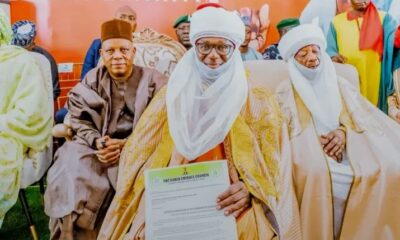



The Federal Government has announced plans to convene the National Youth Confab in October 2026, nearly two years after President Bola Tinubu first pledged to organise the gathering.
The Minister of Youth Development, Ayodele Olawande, disclosed this on Thursday while addressing State House correspondents during the ‘Meet the Press’ session organised by the Presidential Communications Team at the Aso Rock Villa, Abuja.
Olawande said the conference would provide a platform for young Nigerians to participate actively in discussions on the country’s future and develop practical solutions to national challenges.
According to him, the Federal Government, through the Federal Ministry of Youth Development, in collaboration with youth networks and other stakeholders, will convene the conference under the theme, “Next Gen Nigeria: Crafting Solutions, Owning the Future.”
He explained that the theme was designed to move young Nigerians beyond participation in national conversations to taking an active role in developing solutions and shaping the country’s future.
“It is not another youth conference where speeches are delivered, reports are produced, and nothing changes,” Olawande said, stressing that the initiative would focus on moving from discussions to concrete action.
The minister said the Confab would last two weeks and consist of a virtual consultation phase followed by a physical conference in Abuja.
He disclosed that the physical gathering would bring together one delegate from each of the 360 federal constituencies, alongside six delegates representing Nigerians in the diaspora.
The discussions, he added, would be structured around six key pillars covering governance, the economy, education, technology, climate and security.
FG outlines plan to implement recommendations
Olawande said the government had designed an implementation framework to prevent the recommendations of the youth confab from suffering the fate of those produced by the 2014 National Conference.
The 2014 conference produced more than 600 recommendations, many of which were not implemented after a change in administration in 2015.
Addressing concerns about a possible repeat of that experience, Olawande said members of the current administration who participated in the 2014 conference understood the shortcomings of the previous process.
He said the recommendations from the 2026 Confab would be divided according to the responsibilities of the three arms of government.
“We have the executive. We have the legislative… After the conference, we are going to sit down, have our task force, and put everything into three sections: what should be handled by the judiciary, what by the executive, and what by the legislature,” he said.
The minister said the government would seek Federal Executive Council resolutions on recommendations within the executive’s jurisdiction, while proposals requiring legislative action would be forwarded to the National Assembly.
He added that the judiciary would also be expected to act on recommendations falling within its constitutional responsibilities.
Olawande said the implementation process would begin from November, insisting that the government was determined to move beyond producing reports.
“Enough of documentation. We are not going back to filing reports,” he added.
Government addresses concerns over delay
The announcement comes about two years after Tinubu first pledged the initiative during his October 2024 Independence Day broadcast.
The delay has raised questions about the timing of the conference, particularly with the 2027 general elections approaching.
Special Assistant to the President on Social Media, Segun Dada, defended the period spent preparing for the initiative, saying the government had studied previous conferences to identify shortcomings and develop a more effective framework.
“What we did was look at the past confabs, the mistakes that were made, and how to ensure we don’t repeat them,” Dada said.
He also pointed to the involvement of young people in the current administration and the President’s appointment of a young Minister of Youth Development as part of the government’s approach.
The Senior Special Assistant to the President on Digital and New Media, Otega Ogra, similarly defended the timeline, saying several youth-focused programmes had been implemented while preparations for the Confab were ongoing.
Ogra cited the revamp of the National Youth Service Corps, increased participation in the Nigeria Education Loan Fund, employment initiatives through MSME centres, the Technical and Vocational Education and Training programme, and the 3 Million Technical Talent programme.
Delegate selection
Olawande also addressed concerns that the selection of delegates could be influenced by political interests ahead of the 2027 elections.
He maintained that the structure of the Confab was designed to minimise monetary and political influence in the selection process.
The government said the broad representation from the 360 federal constituencies was intended to ensure that young Nigerians from different parts of the country participate in shaping the conference’s agenda and recommendations.
The latest announcement follows an earlier attempt to organise the exercise in 2025.
On June 16, 2025, Olawande launched a Youth Confab registration portal under the same theme, with plans to accommodate 36,000 participants from the 360 federal constituencies.
The registration deadline was subsequently extended from June 30 to July 14, 2025, to allow for wider grassroots participation.
With the new October 2026 timeline, the Federal Government is now expected to commence the final stages of mobilisation, consultation and delegate selection ahead of the physical conference in Abuja.


A chieftain of the All Progressives Congress (APC), Farouk Aliyu, has warned Minister of the Federal Capital Territory, Nyesom Wike, against actions or comments he said could deepen divisions within the ruling party ahead of the 2027 general elections.
Aliyu’s warning followed Wike’s recent description of some APC governors as “politically lazy” and “419ners” while defending his Rainbow Coalition and his support for President Bola Ahmed Tinubu’s re-election bid.
Speaking on Arise Television’s Morning Show on Thursday, Aliyu said APC members would not accept the kind of internal political confrontation Wike had experienced within the Peoples Democratic Party (PDP) being replicated inside the ruling party.
“We will not allow Wike to bring the PDP crisis into our party.”
Aliyu stressed that his criticism was directed at Wike’s political conduct rather than his personality, saying the APC was prepared to accommodate politicians from other parties who were willing to support the President.
‘Wike’s comments are in bad taste’
Aliyu specifically objected to Wike’s description of some APC governors as “lazy” and “419ners.”
He said the remarks were unacceptable to members of the ruling party, particularly at a time when APC leaders were attempting to consolidate support for Tinubu ahead of 2027.
“The language Nyesom Wike used to describe governors as ‘419ners’ or ‘lazy’ is in bad taste. All members of the APC reject that comment.”
Aliyu said political disagreements were inevitable but argued that those supporting the President should avoid language capable of creating further divisions within the party.
He also urged Wike to engage political actors more respectfully, particularly given the broader challenges confronting the Federal Government.
The disagreement follows an escalating dispute between Wike and the APC’s Progressive Governors’ Forum over his Rainbow Coalition, which the FCT minister has promoted as part of his political strategy ahead of 2027.
APC governors recently said they would not support political arrangements capable of weakening the party, creating divided loyalty or undermining APC candidates.
The governors said their commitment was to APC candidates at all levels and that campaign structures should align with the objectives of the party and Tinubu’s re-election effort.
Wike, however, has rejected the idea that his political activities require the approval of APC governors.
He has maintained that his principal political commitment is to Tinubu’s presidential re-election and argued that supporting Tinubu does not prevent politicians from supporting candidates from other parties in governorship or legislative elections.
‘My business is with Tinubu’
Responding to the governors, Wike said his political arrangement was discussed with Tinubu and that he had never presented himself to the APC Governors’ Forum for approval.
He cited the 2023 experience of the G5 governors, who supported Tinubu’s presidential candidacy despite belonging to the PDP.
Wike also pointed to instances where voters supported presidential candidates from one party while electing National Assembly candidates from another, arguing that the Nigerian electorate is capable of making different choices at different levels of an election.
He questioned the political influence of governors who were unable to deliver their states to Tinubu during the 2023 presidential election while winning their own legislative contests.
It was in that context that Wike described some of those opposing his coalition as “politically lazy” and compared them to “419ners.”
Farouk: APC will welcome Wike, but there must be a unified structure
Despite his criticism, Aliyu said the APC was not opposed to Wike supporting Tinubu.
He acknowledged Wike’s contribution to the President’s political fortunes and said politicians from outside the APC could support the ruling party.
According to Aliyu, the problem was the possibility of competing campaign structures operating alongside the APC.
The APC chieftain said the party wanted a unified campaign structure at the national and state levels.
That position closely mirrors the concern expressed by the APC Governors’ Forum, which has rejected arrangements that could produce “confusion, divided loyalty or competing interests” within the party’s campaign architecture.
‘Wike has been settled’
Aliyu also defended Wike’s continued position within the Tinubu administration, noting that the former Rivers governor had been given a prominent federal appointment.
His argument was essentially that Wike had been accommodated within the Tinubu administration and should therefore avoid actions that could generate unnecessary conflict with APC leaders.
However, the dispute is becoming more complicated because Wike remains a member of the PDP while serving as a minister under an APC administration and simultaneously supporting Tinubu’s 2027 presidential bid.
That political arrangement has allowed Wike to maintain relationships across party lines, but it has also generated questions about how his political machinery will operate alongside the APC’s formal campaign structures.
The disagreement is no longer simply a personal exchange between Wike and individual governors.
It reflects a larger question about how Tinubu’s 2027 coalition will be organised.
Wike’s approach is based on building a broad political network that can support Tinubu beyond the formal APC structure.
The APC Governors’ Forum, meanwhile, wants the party’s candidates and campaign machinery to remain central to the electoral process.
Aliyu’s intervention illustrates the tension between those two approaches.
For the moment, Aliyu says Wike remains welcome as a supporter of Tinubu, but the APC’s internal structure cannot be treated as an extension of a separate political coalition.
As the 2027 election approaches, the relationship between Wike’s cross-party political network, Tinubu’s presidential campaign and the APC’s state-level machinery is likely to remain an important political issue.
Leaders and stakeholders of the All Progressives Congress in Benue State have endorsed the re-election bids of Governor Hyacinth Alia and President Bola Tinubu ahead of the 2027 general elections, while cautioning members against actions capable of weakening the party’s unity.
The stakeholders, operating under the Concerned Benue APC Stakeholders and Strategic Alliance, made their position known at a press conference in Abuja on Thursday.
The group’s convener, Dr Dominic Alancha, who addressed journalists, stressed that the APC was bigger than any individual, leader, aspirant or political group.
Alancha urged party members to place the collective interest of the APC above personal disagreements, particularly as the party prepares for the 2027 elections.
He said, “The APC is bigger than any individual, leader, aspirant or political group. Personal disagreements should not be allowed to take precedence over the collective interest of the party.”
The convener disclosed that he had previously opposed Governor Alia’s re-election bid but said he changed his position after reviewing what he described as the broader interest of the party.
According to him, party members with grievances against the governor or APC leadership should use the party’s recognised organs and internal dispute-resolution mechanisms rather than engage in activities that could undermine the party.
“Members who have grievances against the governor or the party leadership should utilise the recognised organs and internal mechanisms of the APC rather than engage in activities that could weaken the party ahead of the 2027 elections,” he said.
Alancha also maintained that any alleged violation of the APC constitution or rules should be handled by the appropriate authorities through due process, regardless of the status or influence of the individuals involved.
The stakeholders backed the Alia administration, arguing that its performance in office provided grounds for the governor to seek another term.
They also declared support for Tinubu’s re-election bid, saying members of the group would mobilise support for both the President and the Benue governor ahead of the 2027 polls.
The group called on APC elders, leaders and members across Benue to resolve their differences through dialogue and make use of the party’s established structures.
Alancha further urged the APC leadership to uphold the supremacy of the party’s constitution and ensure that disciplinary measures, where necessary, were applied fairly and in accordance with established procedures.
He also appealed to Governor Alia to remain focused on governance and the implementation of his administration’s programmes, while urging party members to concentrate on mobilising support for the APC ahead of the 2027 elections.
The stakeholders also appealed to members aligned with different political camps to embrace reconciliation.
They cautioned against what they described as a “rainbow coalition”, which they said could undermine the unity of the party.
“Our position is simple: the party must come first, Benue must come first, and all stakeholders should work towards strengthening the APC ahead of the 2027 general elections,” Alancha said.
The position comes amid wider disagreements within the APC over political alliances ahead of the 2027 elections, particularly involving some APC governors and Minister of the Federal Capital Territory, Nyesom Wike.
The dispute centres partly on the question of whether APC members should support only candidates fielded by the party across different electoral contests.
While the APC governors have maintained support for the party’s candidates, Wike has backed Tinubu’s presidential bid while retaining his position that he should be free to support candidates outside the APC in other contests.
The Benue APC stakeholders, however, said party members should prioritise unity, reconciliation and the strengthening of the party as the 2027 elections approach.
-
 Security2 months ago
NDLEA Declares Alleged Drug Kingpin, Three Associates Wanted, Freezes ₦9.8bn Linked to Syndicate
-

 National Affairs2 months ago
ICPC Uncovers 908 Suspected Ghost Workers Across 50 Federal MDAs, Recovers ₦942 Million
-

 Business/Finance2 months ago
How to Apply for Tunde Onakoya’s ₦250 Million Scholarship Programme and Free Laptop Offer
-
 Politics2 months ago
Atiku Challenges Tinubu to Reveal Details of ₦15.13bn SUV Procurement in 2026 Budget
-

 Judiciary | Public Safety2 months ago
INEC Tells Court Voter Information Is Not Confidential in Emeka Ike’s ₦10bn Lawsuit
-
 Judiciary | Public Safety2 months ago
Court to Rule Friday on NDLEA’s Bid to Destroy ₦480bn Meth Lab in Ogun
-
 Security2 months ago
Family Paid ₦50 Million Ransom to Secure Release of Abducted Kebbi Judge
-

 Breaking News2 months ago
Girl Dies in Uyo House Fire After Allegedly Accompanying Man Home from Nightclub