
Investigations/Anti-Corruption
NAPTIP Seals Port Harcourt Maternity Over Alleged Baby Trafficking, Arrests Three

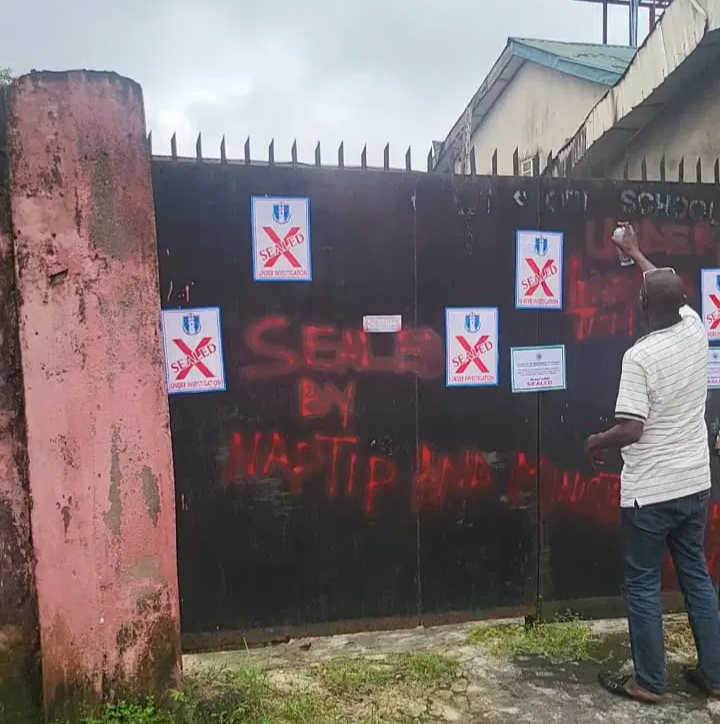
The National Agency for the Prohibition of Trafficking in Persons (NAPTIP) has sealed a maternity facility in Port Harcourt, Rivers State, following allegations of baby trafficking and unlawful child transfers involving a Liberian national based in Belgium.
The agency said its operatives, working with officials of the Rivers State Ministry of Health, arrested the owner of the facility, an alleged facilitator of the suspected baby sale and another staff member during a coordinated operation.
NAPTIP disclosed the development in a statement issued on Thursday, saying the operation followed intelligence received concerning a suspected child trafficking network allegedly operating from the facility.
The development has raised fresh concerns about the vulnerability of children to trafficking through seemingly legitimate healthcare and maternity establishments, particularly facilities operating outside effective regulatory and monitoring systems.
According to NAPTIP, the facility is located in the Elelenwo area of Port Harcourt and was allegedly operating from a residential apartment.
Preliminary findings, the agency said, suggested that the premises may have been used for the procurement, sale and unlawful transfer of children.
NAPTIP stressed that investigations were still ongoing and that the full circumstances surrounding the alleged transactions had not yet been established.
The agency is particularly investigating how the children came into the custody of the individuals involved, the identities of their biological parents and whether proper legal processes were followed in any purported adoption or transfer.
One of the most significant aspects of the investigation involves a Liberian national living in Belgium.
NAPTIP said preliminary investigations indicated that the woman arrived in Nigeria without evidence of pregnancy, but allegedly took custody of three children within approximately one month.
The agency said intelligence available to investigators suggested that about N13.5 million changed hands in connection with the transfer of the three children and other persons associated with the maternity facility.
NAPTIP has not, however, concluded that the money definitively represented payment for the children.
That is one of the issues investigators are expected to establish as the probe progresses, including who paid the money, who received it, the purpose for which it was transferred and whether the transactions were connected to the alleged procurement or trafficking of the children.
NAPTIP said its investigation would go beyond the maternity facility itself.
Investigators are conducting forensic and documentary examinations to establish the identities, whereabouts and welfare of the affected children, as well as determine their biological and legal parentage.
The agency is also seeking to identify individuals who may have participated in the alleged procurement, transfer or facilitation of the children.
Financial records and other transactions linked to the suspected operation are also being examined.
This aspect of the investigation could prove important in determining whether the alleged activity was an isolated incident or part of a broader organised network.
NAPTIP said it would also examine the possible involvement of medical personnel and other individuals who may have facilitated the alleged transactions.
Following the operation, NAPTIP and the Rivers State Ministry of Health sealed the maternity facility.
The agency said the decision was taken partly to preserve the scene and protect potential evidence while investigations continue.
The joint operation involving federal anti-trafficking officials and state health authorities also underscores the importance of cooperation between law-enforcement agencies and regulatory bodies when allegations of child trafficking emerge from healthcare facilities.
Investigators will now be expected to establish whether the facility was properly licensed, the nature of services it provided and whether its operators complied with relevant regulations governing maternity services, births and child custody.
NAPTIP Director-General, Binta Adamu Bello, expressed concern over what she described as the activities of some maternity and healthcare facility operators across the country.
She specifically raised concerns about alleged involvement in illegal adoption, child sale and trafficking.
Bello described the alleged involvement of a foreign national in the case as particularly troubling.
“I am particularly disturbed that foreign nationals now come to Nigeria to patronise these suspected criminal elements and procure children like a common object of trade across the border. This is sad and totally unacceptable.”
The NAPTIP chief said the agency had expanded its investigation to identify everyone allegedly connected to the case.
“We have spread our dragnet to fish out all those involved in this case, and they shall be made to face the full wrath of the law.”
She nevertheless stressed that the investigation would follow due process and that individuals would be held accountable only after the relevant facts had been established.
The case highlights the complex nature of child trafficking in Nigeria, where traffickers can exploit vulnerable families, informal adoption arrangements and gaps in institutional oversight.
Child trafficking does not necessarily involve the stereotypical image of children being abducted from the streets.
In some cases, trafficking can involve the unlawful transfer of children through intermediaries, fraudulent documentation, illegal adoption arrangements or financial transactions disguised as legitimate medical or social services.
This makes healthcare facilities particularly important in the prevention and detection of child trafficking.
Maternity homes, hospitals and other facilities involved in childbirth and maternal care can potentially provide traffickers with access to newborns and vulnerable families if effective identification, documentation and regulatory systems are absent.
The reported N13.5 million transaction is likely to be one of the central areas of the investigation.
NAPTIP’s preliminary intelligence suggests that the amount was connected to the transfer of the three children and other members of staff of the maternity.
Investigators will need to establish the precise nature of the transactions and whether they constitute proceeds of an alleged trafficking operation.
Financial tracing could also help investigators determine whether other individuals or organisations were involved.
If the investigation uncovers a wider financial network, authorities could potentially identify other persons who allegedly benefited from the suspected operation or facilitated the movement of children.
For now, NAPTIP has not announced a final conclusion on the case.
The arrested individuals remain subject to investigation, while the agency works to establish the facts surrounding the children and the alleged transactions.
The most immediate priority, according to NAPTIP, is the safety and welfare of the affected children.
The agency must also determine their biological identities, establish whether they have legitimate parents or guardians and ascertain the legal circumstances under which they came into the custody of the foreign national.
Any subsequent prosecution will depend on evidence gathered during the investigation.
The agency’s statement therefore does not amount to a conviction of the arrested persons or establish that every allegation made against them is true. Those issues will ultimately be determined through investigation and, where charges are filed, the judicial process.
The Port Harcourt case could have implications beyond the facility that has now been sealed.
If investigators establish that children were being procured or transferred through an organised network, authorities may need to examine similar maternity facilities and informal adoption arrangements in other parts of the country.
It also raises questions about how effectively births, custody arrangements and adoptions involving foreign nationals are monitored.
For NAPTIP, the challenge will be to ensure that the investigation does not stop with the immediate suspects.
A successful investigation would need to identify the entire chain involved — from those who allegedly sourced the children to those who facilitated their documentation, movement, payment and eventual transfer.
For the children at the centre of the case, however, the most important outcome is not simply prosecution.
It is ensuring that they are safe, properly identified and ultimately placed under lawful and appropriate care.





The Code of Conduct Tribunal has commenced efforts to secure the approval of the National Assembly to transform the tribunal into a full-fledged National Anti-Corruption Court aimed at accelerating the prosecution and determination of corruption cases in Nigeria.
The Acting Director of Litigation of the CCT, Yahaya Laraski, disclosed this in a statement on Monday while highlighting the achievements of the tribunal’s new leadership and outlining some of the challenges affecting its operations.
According to Laraski, the proposed transformation is being pursued through an Executive Bill with the support of the Attorney-General of the Federation and the Secretary to the Government of the Federation.
He explained that the proposed National Anti-Corruption Court would operate through seven judicial divisions located across the country, with 37 judges assigned to handle corruption-related cases.
“The new Chairman is pressing the National Assembly, through the Attorney General of the Federation and the Secretary to the Government of the Federation, for an Act, as an Executive Bill, to change the name to ‘National Anti-Corruption Court’ as a full-fledged Court with seven Judicial Divisions across Nigeria, to be trying all cases of Anti-Corruption,” Laraski said.
He added that the proposed court would have jurisdiction to hear cases brought by anti-corruption agencies and other relevant institutions, as well as civil society organisations.
Under the proposed arrangement, agencies including the Economic and Financial Crimes Commission, Independent Corrupt Practices and Other Related Offences Commission, Code of Conduct Bureau, Public Complaints Commission and National Human Rights Commission would be able to prosecute cases before the court.
Laraski further disclosed that the court would adopt a summary trial system designed to ensure that corruption cases are concluded within six weeks of arraignment.
“It will be a court of summary trial, whereby all cases must be dispensed with within a period of six weeks from the arraignment date,” he said.
CCT recovers two properties
Speaking on the tribunal’s recent achievements, Laraski said the new leadership had recovered two of its three estate properties which were allegedly sold illegally.
He identified the recovered properties as the official residence of the chairman and the North-Eastern States Zonal Office in Bauchi.
He also disclosed that the status of the tribunal’s chairman had been elevated to that of the Chief Judge of the Federal High Court, while members of the tribunal now have the status of Federal High Court judges.
According to him, the tribunal has also created seven additional departments to complement its three existing departments.
Laraski said outstanding staff promotions had been implemented, while 13 new allowances had also been introduced.
He added that staff members had participated in more than 20 capacity-building training programmes within one year as part of efforts to strengthen the tribunal’s effectiveness.
CCT raises funding concerns
Despite the developments, Laraski identified inadequate case inflow and funding as major challenges confronting the tribunal.
He said the number of cases handled by the CCT depended largely on referrals from the Code of Conduct Bureau, limiting the tribunal’s ability to independently determine the volume of cases before it.
“The first is that inflow of cases to our Tribunal is determined only by the discretion of the Code of Conduct Bureau. Any case they want is the one we can adjudicate upon,” he said.
On funding, Laraski said the tribunal had faced difficulties accessing its approved N2bn budgetary allocation.
“There is gross inadequacy of funding because we hardly get the N2 billion budget funded by the government,” he said.
He appealed to the Federal Government to provide the tribunal with essential facilities, including furniture, information and communication technology equipment, vehicles and additional capacity-building opportunities for its personnel.
The proposed transformation of the CCT into a National Anti-Corruption Court, if approved, is expected to introduce a specialised judicial framework for corruption cases and potentially reduce delays in the prosecution of such matters.
Investigations/Anti-Corruption
Tinubu Orders Arrest of George Buchi Nwabueze, Suspends Three Permanent Secretaries Over Fake Agency


President Bola Ahmed Tinubu has ordered the immediate arrest of Prince George Buchi Nwabueze following the discovery of another alleged fake government office operating within the premises of the Office of the Secretary to the Government of the Federation (OSGF).
The President also directed the immediate suspension of three permanent secretaries allegedly linked to the circumstances surrounding the discovery.
The affected officials are M.S. Danjuma, Nadungu Gagare and Richard P. Pheelangwah.
The latest development was disclosed on Friday by the Chairman of the Independent Corrupt Practices and Other Related Offences Commission (ICPC), Dr Musa Aliyu, SAN, while briefing State House correspondents.
Aliyu said the latest discovery was made during the commission’s ongoing investigation into fictitious government agencies and weaknesses within the public service.
According to him, the agency identified an entity operating under the name “National Brands Development and Made-in-Nigeria Special Project Office.”
The alleged office was reportedly allocated space within the premises of the OSGF despite not having presidential authorisation or the legal status required to operate as a government agency.
Aliyu said the discovery followed an earlier investigation into the alleged Presidential Foreign Intervention Promotion Council (PFIFC), which President Tinubu had directed the ICPC to investigate.
He said the commission had briefed the President for the second time within two days as investigators uncovered additional details.
“The Independent Corrupt Practices and Other Related Offences Commission has uncovered another fake agency and office operating under the name National Brands Development and Made-in-Nigeria Special Project Office, which has been illegally allocated office space within the premises of the Office of the Secretary to the Government of the Federation.”
The ICPC chairman identified Prince George Buchi Nwabueze as the alleged promoter of the newly uncovered office.
Aliyu said investigators discovered that Nwabueze allegedly operated under several variations of his name.
These include George Nathan, George Nathan Nwabueze, Honourable George Buchi Nwabueze, Prince George Buchi Nwabueze and George Nwabueze.
The ICPC chairman also alleged that the promoter had active suspected collaborators within the OSGF.
According to the commission, the office was established and given official space without authorisation from the President and contrary to existing public service regulations.
Following the briefing, President Tinubu directed the immediate arrest of Nwabueze.
The President also ordered the suspension of the three permanent secretaries named by the ICPC pending further investigation.
Aliyu said:
“Mr President has directed as follows: the immediate arrest of Prince George Buchi Nwabueze; the immediate suspension of the following permanent secretaries; M.S. Danjuma, Nadungu Gagare, and Richard P. Pheelangwah.”
The ICPC chairman said the commission would continue its investigation and work with the OSGF to obtain information necessary to establish how the alleged fake office was created and allowed to operate within government premises.
The latest discovery represents a further expansion of an investigation that began after authorities uncovered the alleged fictitious Presidential Foreign Intervention Promotion Council.
The self-styled Director-General of that organisation, Adeniyi Adeyemi Matthew, is currently facing prosecution over allegations including forgery and impersonation.
An interim ICPC report submitted to President Tinubu on August 6 after a 30-day investigation had already identified two other alleged fictitious bodies.
They were the FCT Investment Promotion Agency and the Foreign Investment Promotion Agency and Public-Private Partnership.
The newly uncovered National Brands Development and Made-in-Nigeria Special Project Office therefore becomes the fourth alleged fake agency or government body identified in connection with the broader investigation.
The commission is now examining how the latest organisation allegedly obtained office space inside the OSGF and whether government officials knowingly or unknowingly facilitated its activities.
The investigation is expected to establish the identities and roles of individuals allegedly involved, determine how the office gained access to government premises and examine any documents or financial transactions connected to its activities.
The ICPC has also continued discussions with officials of the OSGF as part of efforts to establish the circumstances surrounding the alleged unauthorised office.
Aliyu said the commission had comprehensively briefed the President on the latest findings and would proceed with its investigation.
The development raises fresh concerns about weaknesses in Nigeria’s public-service verification and administrative control systems, particularly where individuals or organisations allegedly present themselves as government-approved entities.
For the affected permanent secretaries, their suspension is expected to allow investigators to examine whether there was any administrative failure or misconduct connected to the allocation of government premises.
The ICPC has not yet announced the conclusion of its investigation, and allegations against the individuals involved remain subject to due process.
Investigations/Anti-Corruption
Court Orders Final Forfeiture of 48 Properties Linked to Former AGF Abubakar Malami

The Federal High Court in Abuja has ordered the final forfeiture of 48 properties linked to former Attorney-General of the Federation and Minister of Justice, Abubakar Malami (SAN), to the Federal Government after ruling that the Economic and Financial Crimes Commission (EFCC) established that the assets were reasonably suspected to have been acquired with proceeds of unlawful activities.
Justice Joyce Abdulmalik, who delivered the judgment on Wednesday, held that the EFCC successfully demonstrated that the properties were not acquired from lawful sources of income.
The court further ruled that Malami, his family members, and other respondents failed to provide sufficient evidence showing the legitimate sources of funds used to acquire the assets.
The judgment marks a significant victory for the EFCC in one of its largest non-conviction-based asset recovery cases in recent years.
Court Rejects Challenge to Forfeiture
The final order followed months of legal proceedings after the EFCC secured an interim forfeiture order from Justice Emeka Nwite on January 6, 2026.
In compliance with the court’s directive, the anti-graft agency published notices in national newspapers, inviting interested parties to show cause why the assets should not be permanently forfeited to the Federal Government.
Malami, alongside 14 family members and associates, challenged the interim order, questioning the jurisdiction of the court and insisting that the assets should not be forfeited.
However, after hearing arguments from both sides, Justice Abdulmalik ruled that the respondents merely claimed ownership of the properties without presenting credible evidence that they were acquired through legitimate means.
The court emphasised that under Nigeria’s non-conviction-based forfeiture framework, respondents bear the responsibility of demonstrating the lawful origin of assets reasonably suspected to be proceeds of unlawful activities.
University, Hotels, Radio Station Among Forfeited Assets

The forfeited assets span several states and include residential, commercial, educational and industrial properties.
Among the most prominent assets are Rayhaan University in Kebbi State, including its permanent and temporary campuses, the Vice-Chancellor’s residence and related university facilities.
Also forfeited is Rayhaan Radio in Birnin Kebbi, along with the Rayhaan Agro-Allied Factory, its processing plants, factory buildings, staff quarters and supporting infrastructure.
The court also ordered the forfeiture of luxury hotels, including Meethaq Hotels in Maitama and Jabi, Abuja, as well as the 131-room Zeennoor Hotel in Kano.
Other properties covered by the order include residential estates, luxury duplexes, commercial plazas, shopping complexes, warehouses, filling stations, agricultural land, hotels, office buildings and several undeveloped plots located across Abuja, Kebbi, Kano and Kaduna States.
Among the assets are Azbir Arena, hotel and commercial facilities in Kebbi State, shopping units in Wuse Market and Vegas Mall, Gwarimpa residential properties, and extensive parcels of land along the Birnin Kebbi–Jega Road.
One of EFCC’s Largest Asset Recoveries
The forfeiture represents one of the most extensive asset recovery exercises undertaken by the EFCC, involving dozens of high-value properties spread across multiple sectors, including education, hospitality, agriculture, energy, real estate and broadcasting.
The anti-graft agency argued that the assets were proceeds of unlawful activities and sought their permanent transfer to the Federal Government under Nigeria’s civil forfeiture laws.
Civil Forfeiture Different from Criminal Conviction
Legal experts note that the judgment relates to civil asset forfeiture proceedings, which differ from criminal prosecution.
Under Nigerian law, a court may order the forfeiture of assets reasonably suspected to be proceeds of unlawful activities if respondents fail to establish their lawful origin. Such proceedings do not, on their own, amount to a criminal conviction.
The court stressed that ownership alone is insufficient to defeat a forfeiture application where the lawful source of funds used to acquire the assets cannot be satisfactorily explained.
The EFCC has consistently maintained that non-conviction-based forfeiture remains a vital tool in Nigeria’s fight against corruption, allowing the recovery of assets believed to have been acquired through illicit means while separate criminal proceedings, where applicable, continue before the courts.
-
 Security2 months ago
NDLEA Declares Alleged Drug Kingpin, Three Associates Wanted, Freezes ₦9.8bn Linked to Syndicate
-
 National Affairs2 months ago
ICPC Uncovers 908 Suspected Ghost Workers Across 50 Federal MDAs, Recovers ₦942 Million
-

 Business/Finance2 months ago
How to Apply for Tunde Onakoya’s ₦250 Million Scholarship Programme and Free Laptop Offer
-

 Politics2 months ago
Atiku Challenges Tinubu to Reveal Details of ₦15.13bn SUV Procurement in 2026 Budget
-

 Judiciary | Public Safety2 months ago
INEC Tells Court Voter Information Is Not Confidential in Emeka Ike’s ₦10bn Lawsuit
-
 Judiciary | Public Safety2 months ago
Court to Rule Friday on NDLEA’s Bid to Destroy ₦480bn Meth Lab in Ogun
-
 Security2 months ago
Family Paid ₦50 Million Ransom to Secure Release of Abducted Kebbi Judge
-
 Breaking News2 months ago
Girl Dies in Uyo House Fire After Allegedly Accompanying Man Home from Nightclub