
News
Rufai Oseni and the Burden of Objectivity: Is Tough Journalism Bias?


Rufai Oseni’s approach to television journalism has continued to generate debate, with critics often accusing the Arise Morning Show anchor of bias, aggression and unprofessional conduct.
But is strong questioning necessarily evidence of political bias? Or does Oseni sometimes simply allow his convictions and emotions to become too visible in interviews?
After I wrote an intervention on last week’s incident on the Arise Morning Show, a friend, who is one of the leaders of public relations practice in Nigeria, sent me a message asking for my professional assessment of Oseni.
I replied: “I think he’s bright, patriotic, and objective. But he gets too emotional and descends into the arena, sometimes doing more than a journalist should do.”
My friend, who said they had known Oseni personally for years, disagreed strongly.
“Really? He lacks every trait of a professional journalist!” they responded, suggesting that the television anchor required further professional training.
I did not pursue the argument for two reasons. First, I do not disagree that Oseni, like every other professional, requires continuous training and retraining. Professional education is never truly complete.
Second, I decided that the better response would be to explain my position more fully.
I will therefore admit from the outset that, while many Nigerians describe Rufai Oseni as biased, I do not share that assessment.
I understand why some people, particularly those on the receiving end of his sometimes vigorous and relentless interrogation of issues and personalities, may consider him partisan, arrogant or unprofessional.
But I do not see him that way.
And I say this as someone who follows the Arise Morning Show with considerable interest.
Over the years, I have observed that Oseni, alongside his colleagues, Dr Ruben Abati, Ayo Mairo-Ese and, occasionally, Vimbai Mutinhiri-Ekpenyong, generally hold their guests to similar standards of accountability, good governance and responsibility.
Oseni is, in my view, one of the most brilliant television journalists on Nigerian television today.
He is well-read, has an impressive command of facts and figures, and demonstrates a level of preparation that should arguably be a minimum requirement for anyone given the privilege of anchoring a morning programme on national television.
He remembers what public officials said months earlier. He retrieves figures.
He points out contradictions. He presses guests when they attempt to evade questions.
He is also visibly passionate about Nigeria.
That passion is evident in virtually every discussion.
I cannot imagine why a country should demand less of its journalists than knowledge, preparation, courage and a genuine concern for the public interest.
So, why does Oseni sometimes come across as biased or unprofessional to sections of the viewing public?
Part of the answer lies in understanding the format of the Arise Morning Show.
The programme’s principal anchors perform at least two different functions. They are journalists, but they are also analysts.
During some segments, particularly the opening discussions, they are not merely reporting what happened. They are interpreting developments, interrogating policies and examining political positions and public issues.
In that capacity, they can draw conclusions from political conduct and express their personal views.
The same principle applies to other segments of the programme, including The Brief with Rotus Odiri, World Brief, Newspapers Review by Akinfemi Adesanya, Sports and What’s Trending.
There is an important distinction between straight news reporting and other forms of broadcast journalism.
For example, the United Kingdom’s broadcast regulator, Ofcom, recognises that presenters outside news programmes, including personal-view programmes and discussion programmes, may express their views on matters of political controversy or current public policy, provided that alternative viewpoints are adequately represented and the presenter does not use their platform in a manner that compromises due impartiality.
There is therefore nothing inherently wrong with an analyst telling viewers what they think.
An analyst who is afraid to reach a conclusion or communicate it clearly may not be doing the job expected of an analyst.
If two positions contradict each other, the analyst should be able to say so.
If a policy appears incoherent, the analyst should explain why. If someone’s conduct raises questions about competence, integrity or consistency, those questions should be raised, provided the assessment is grounded in facts.
It should not matter whose political interest is affected.
The difficulty begins when an analyst fails to completely surrender that role when the programme moves into an interview.
That is where the distinction becomes important.
The interviewer has a different responsibility from the analyst.
An interviewer should not enter an interview determined to prove that his own opinion is correct.
The guest has been invited to answer questions and provide information to the audience.
The journalist’s responsibility is therefore to ask relevant questions, interrogate the answers, introduce contradictory evidence where necessary and give viewers enough information to reach their own conclusions.
This does not mean the interviewer should be timid.
Anyone, particularly a public official appearing on television, should expect difficult questions.
They should also expect follow-up questions.
If a guest evades a question, the interviewer should return to it.
If the guest contradicts an earlier statement, the journalist should point it out.
If the available facts differ from the guest’s claims, the journalist has a responsibility to challenge those claims.
That is not bias.
That is journalism.
This is where some of the criticism against Oseni misses the point.
Tough or relentless questioning is not necessarily evidence of bias.
Similarly, interruption is not automatically rude or unprofessional.
There are occasions when a journalist must interrupt because a guest is avoiding a question, taking disproportionate airtime or turning an interview into a promotional exercise.
But adversarial journalism is not the same thing as argumentative journalism.
The line between interrogating a guest’s argument and arguing with the guest during an interview is very thin.
Journalists must be careful not to cross it.
And Oseni does not always need to cross that line because he is usually sufficiently prepared.
In my opinion, the better prepared an interviewer is, the less he sometimes needs to say.
The interviewer should put the facts before the guest, ask the question and then have the discipline to listen.
If the guest prevaricates, repeat the question.
If the guest contradicts himself, ask him to reconcile the contradiction.
If he cannot, allow the audience to draw its own conclusion.
The journalist has already made the point.
The audience is not stupid.
It is capable of understanding what it has heard.
An interview should therefore not degenerate into a shouting match simply because the interviewer wants his own position to prevail.
The desire to prove that one’s opinion is right should be almost invisible during an interview.
This, in my view, is where Oseni occasionally gets into trouble with both guests and viewers.
Sometimes, he appears so emotionally invested in demonstrating that he is correct that the question becomes too long.
The supplementary question becomes an explanation.
The explanation becomes an argument.
And before long, viewers are watching two people struggling to establish who has the superior position instead of watching a journalist extract useful information from a guest.
At such moments, the audience can become confused rather than educated.
The spectacle can also become embarrassingly unedifying.
Despite these concerns, however, it would be difficult to sustain the charge that Oseni is politically biased based solely on his interviewing style.
A journalist’s strong views or aggressive questioning should not automatically be interpreted as allegiance to an opposing political tendency.
The more useful test of objectivity is consistency.
Does the interviewer subject claims to equivalent scrutiny regardless of who makes them?
Does he interrogate evasions from politicians he is presumed to favour with the same intensity with which he challenges those he is presumed to dislike?
Does he treat evidence with the same seriousness regardless of the political tendency of the person presenting it?
Those are fair questions for Oseni, his colleagues on the Arise Morning Show and, indeed, every journalist.
On these questions, I do not recall persuasive evidence that Oseni has used his platform to advance the electoral fortunes of one political tendency over another.
Rather, he repeatedly demands that government deliver for the people and insists that political candidates should go beyond making promises to explain how those promises will be achieved.
What I see is a journalist with a strong passion for seeing Nigeria work, but who occasionally allows his convictions to become too visible and dominate interviews with people whose views differ from his.
That may contradict the restraint expected of a journalist, but it is not necessarily proof of political bias.
The problem is that the average viewer may not always make that distinction.
And that is where professional restraint becomes critical.
Journalism derives much of its power from credibility, and credibility depends not only on what journalists intend but also on how their conduct is perceived.
When viewers believe they already know an interviewer’s position before a guest has even answered the first question, the journalist has a problem.
The perception may be unfair.
It may even be completely wrong.
But perception matters.
Oseni therefore needs restraint, just as every journalist does.
He also needs to clearly distinguish between his different roles when he moves between analyst and interviewer on the same programme.
Nigeria should never lack television interviewers who possess knowledge, courage and the willingness to ask difficult questions.
But courage must be accompanied by discipline.
A journalist must resist the temptation to complete an argument for a guest, win an argument against a guest or force personal opinions down the throats of viewers.
The journalist’s job is not to win.
It is to inform.
When that thin line is crossed, an interviewer risks creating an impression of partisanship even when he is not necessarily partisan.
And that, ultimately, is the burden of objectivity.





Vice President Kashim Shettima has commissioned a garment factory in Ilorin, Kwara State, with the capacity to employ about 4,000 people when operating at full capacity.
Shettima also commissioned the 11-storey Kwara Revenue Service House as part of activities marking the turbaning of Kwara State Governor AbdulRahman AbdulRazaq as the Sardauna of Ilorin.
The development was disclosed in a statement issued on Wednesday by the Senior Special Assistant to the President on Media and Communications, Office of the Vice President, Stanley Nkwocha.
According to the statement, the garment factory is one of the signature projects of the AbdulRazaq administration and was designed to create employment opportunities for at least 4,000 people when fully operational.
The commissioning of the two projects formed part of activities surrounding the conferment of the traditional title on AbdulRazaq by the Emir of Ilorin, Alhaji Ibrahim Sulu-Gambari.
The Emir described the governor as the “Defence Minister of Ilorin Emirate” during the turbaning ceremony held at the Emir’s Palace in Ilorin.
Speaking at the ceremony, Shettima commended what he described as the legacy of continuity maintained by the AbdulRazaq administration in Kwara State.
The Vice President also reflected on the contribution of the governor’s late father, AbdulGaniyu AbdulRazaq, to the history of Ilorin and Nigeria’s legal profession.
Shettima noted that AbdulGaniyu AbdulRazaq made history as the first lawyer from Northern Nigeria, describing his legacy as one that had continued to resonate across generations.
“His father, Alhaji AbdulGaniyu AbdulRazaq, carried an Ilorin name into history as Northern Nigeria’s first lawyer,” Shettima said.
He also recalled that the late AbdulRazaq was the first Mutawalle of Ilorin, saying the title remained in the family as a reflection of its longstanding relationship with the Ilorin Emirate.
Shettima said AbdulRazaq’s turbaning provided an opportunity to reflect on how legacies and family names could be carried from one generation to another.
“As Governor AbdulRazaq receives his turban, we remember those who preceded him, and we offer prayers for the generations who will encounter this occasion through the stories their elders preserve,” he said.
The Vice President also spoke about his relationship with AbdulRazaq, describing him as a friend with whom he regularly discusses issues relating to governance and national development.
He said their responsibilities intersect at the National Economic Council, where issues concerning the federation and its constituent states are discussed.
According to Shettima, such responsibilities require governments to consider how economic proposals relate to implementation, financing and the needs of communities.
He said the success of Nigeria’s federal system depended on sustained dialogue among those entrusted with governing the country and meeting the needs of its citizens.
“A federation is sustained through the patient conversation between those who share responsibility for its people. No boundary on an administrative map can divide the dignity Nigerians are entitled to expect,” he said.
The Vice President also highlighted AbdulRazaq’s role as Chairman of the Nigeria Governors’ Forum, noting that the governor participates in engagements with the Federal Government and development partners.
Shettima said behind such institutional engagements was the broader responsibility of addressing the needs of farmers, households and businesses across the country.
He further commended AbdulRazaq’s administration for investments in education, healthcare and road infrastructure in Kwara State.
“These are chapters in the story of a state as its people encounter it: the lesson a child can attend, the treatment a household can seek, and the market a farmer can reach,” he said.
Shettima urged that such investments be sustained so future generations could build on them, stressing that the true measure of a legacy was its continued benefit to the people.
The statement noted that the turbaning made AbdulRazaq the first person to bear the traditional title of Sardauna of Ilorin.
The ceremony attracted several dignitaries, including the governors of Imo, Kebbi, Plateau, Ekiti, Ogun, Niger, Bayelsa and Kaduna states.


Kano State Governor, Abba Yusuf, has congratulated his Kwara State counterpart and Chairman of the Nigeria Governors’ Forum, Abdulrahman Abdulrazaq, on his turbaning as the Sardauna of Ilorin.
Yusuf’s congratulatory message was contained in a statement issued by his spokesperson, Sunusi Dawakin-Tofa, on Tuesday.
The Kano governor described the traditional title as a well-deserved recognition of Abdulrazaq’s leadership qualities, commitment to good governance and contributions to the development and unity of Nigeria.
According to Yusuf, the conferment of the prestigious title reflects the confidence and respect that the people and traditional institution of Ilorin have in Abdulrazaq’s leadership and service to humanity.
“The conferment of the prestigious traditional title further reflects the confidence and respect the people and traditional institution of Ilorin have in Governor AbdulRazaq’s leadership and service to humanity,” Yusuf was quoted as saying.
He prayed for continued wisdom, strength and good health for the Kwara governor to enable him discharge his responsibilities effectively and contribute to the peace, progress and prosperity of Kwara State and Nigeria.
Yusuf also wished the Chairman of the Nigeria Governors’ Forum continued success in his service to the people, while congratulating him on the historic occasion.
The turbaning ceremony was attended by dignitaries, with Vice President Kashim Shettima also commissioning the 11-storey Kwara Revenue Service House as part of activities marking Abdulrazaq’s installation as the Sardauna of Ilorin.
Speaking during the event, Shettima also used the occasion to call for political reconciliation among politicians in Kwara State and across the country ahead of the 2027 general elections.
The Vice President cited President Bola Tinubu’s response to northern governors who opposed his presidential ambition during the 2023 election, saying the President demonstrated political maturity by forgiving those who did not support him.
Shettima urged politicians in Kwara to adopt a similar approach by reconciling after political contests and avoiding the escalation of disagreements into permanent divisions.
He said political contests should be regarded as temporary, stressing the need for unity and issue-based politics as the country approaches another election season.
“I call on all of us to unite in this political season and play politics without bitterness. The truth that sets us free is also the truth that people don’t want to hear,” he said.
Shettima added, “After the 2023 election, President Tinubu hugged and forgave all other northern governors who did not support him. That is a mark of a good leader.”
The Vice President’s appeal comes as political activities intensify ahead of the 2027 elections, with political actors across the country already beginning to position themselves and their parties for the forthcoming electoral contest.
The turbaning of Abdulrazaq as Sardauna of Ilorin therefore provided an opportunity for political and traditional leaders to highlight the importance of unity, reconciliation and cooperation in advancing the interests of Kwara State and Nigeria.

Former Barcelona and Netherlands coach Ronald Koeman has announced the death of his wife, Bartina Koeman.
Koeman shared the heartbreaking news on Wednesday in a tribute posted on his Instagram page, describing Bartina as his “beautiful wife” and the family’s “dearest mother and grandmother.”
“With intense sadness, but also with great pride and love, we say goodbye to my beautiful wife, our dearest mother and grandmother,” Koeman wrote.
Following the announcement, Barcelona expressed its condolences to the former manager and his family, offering its support during the difficult period.
“FC Barcelona and its supporters send their deepest condolences and affection to Ronald Koeman and his family for the passing of his wife, Bartina Koeman. May she rest in peace,” the Spanish club said.
The Netherlands national team also paid tribute to Bartina and extended its sympathies to Koeman, their children, grandchildren and other members of the family.
“We wish Ronald, their (grand)children, family, and other loved ones a great deal of strength and support in the face of this great loss,” the national team said.
Koeman, 63, is one of the most recognisable figures in Dutch football, having enjoyed a highly successful playing career before moving into coaching and management.
As a player, he was known for his defensive ability, passing range and powerful set-piece strikes. He was also part of the Netherlands team that won the 1988 European Championship.
After retiring from playing, Koeman embarked on a managerial career that took him to several leading clubs and national teams.
He managed Barcelona between 2020 and 2021, winning the Copa del Rey during his spell at the Catalan club. He also had managerial stints with the Netherlands, Everton, Southampton and Ajax, among other clubs.
Koeman returned to the Netherlands national team for a second spell as head coach in 2023 after previously managing the side between 2018 and 2020.
Koeman and Bartina had been married for decades and had three children together. They also became grandparents during their long marriage.
The family has requested privacy as they mourn Bartina’s death and come to terms with their loss.
Tributes have continued to emerge from the football community as clubs, players and supporters offer their condolences to Koeman and his family.
-
 Security2 months ago
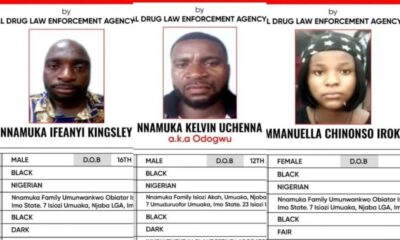
NDLEA Declares Alleged Drug Kingpin, Three Associates Wanted, Freezes ₦9.8bn Linked to Syndicate
-
 National Affairs2 months ago
ICPC Uncovers 908 Suspected Ghost Workers Across 50 Federal MDAs, Recovers ₦942 Million
-

 Business/Finance2 months ago
How to Apply for Tunde Onakoya’s ₦250 Million Scholarship Programme and Free Laptop Offer
-
 Politics2 months ago
Atiku Challenges Tinubu to Reveal Details of ₦15.13bn SUV Procurement in 2026 Budget
-

 Judiciary | Public Safety2 months ago
INEC Tells Court Voter Information Is Not Confidential in Emeka Ike’s ₦10bn Lawsuit
-
 Judiciary | Public Safety2 months ago
Court to Rule Friday on NDLEA’s Bid to Destroy ₦480bn Meth Lab in Ogun
-
 Breaking News2 months ago
Girl Dies in Uyo House Fire After Allegedly Accompanying Man Home from Nightclub
-
 Security1 month ago
Family Paid ₦50 Million Ransom to Secure Release of Abducted Kebbi Judge