
Business/Finance
Coca-Cola Targets Fresh $1bn Investment in Nigeria Over Five Years


The Coca-Cola System in Nigeria has announced plans to invest an additional $1 billion in the country over the next five years, subject to the availability of a predictable and enabling policy environment.
The company disclosed this in a statement shared with PUNCH Online on Saturday, following a new socio-economic assessment of its operations in Nigeria conducted by global consultancy, Steward Redqueen, in 2024.
The assessment examined the economic contributions of the Coca-Cola System, comprising Coca-Cola Nigeria Limited and its authorised bottler, Nigerian Bottling Company.
The study used the Leontief input-output economic model, an economic framework used to assess how activities in one sector affect other parts of an economy.
According to the report, the Coca-Cola System supported approximately 160,200 jobs across its value chain during the period under review.
Of the figure, 2,989 were direct employees, while more than 157,200 additional jobs were sustained indirectly across sectors including agriculture, logistics, retail, hospitality and distribution.
The study found that for every job created directly by the company, an additional 53 jobs were supported elsewhere in the Nigerian economy, highlighting the multiplier effect of its operations and supply chain.
Beyond employment, the assessment estimated that the Coca-Cola System generated approximately $1 billion in value-added economic activity in Nigeria during the period examined.
It also revealed that the company spent about $601 million annually on goods and services sourced from local suppliers.
The report said a significant proportion of the ingredients, packaging materials and other production inputs used by the Coca-Cola System are sourced, produced and distributed locally.
According to the assessment, the local sourcing model has strengthened the company’s links with Nigeria’s agricultural, manufacturing and logistics sectors while creating economic opportunities for businesses and individuals.
Coca-Cola highlights sustainability investments
The assessment also highlighted Coca-Cola’s investments in environmental sustainability, particularly waste management and water stewardship.
It cited the launch of a packaging collection hub in Apapa, Lagos, with the capacity to process 13,000 metric tonnes of PET plastic annually.
The facility is expected to support approximately 1,000 informal waste collectors while contributing to the development of Nigeria’s recycling ecosystem.
According to the study, the hub is designed to improve plastic recovery and strengthen livelihoods connected to waste collection and recycling.
The report also highlighted a $25 million Africa-wide water stewardship initiative covering 20 markets, including Nigeria.
It said communities in Borno and Imo states have benefited from interventions including borehole rehabilitation, sanitation infrastructure and riverbank restoration.
The projects were reported to have impacted more than 2.6 million people.
The assessment concluded that the Coca-Cola System’s contribution to Nigeria extends beyond beverage production, with its activities spanning employment, local procurement, environmental sustainability and community development.
It said continued alignment between the company’s global expertise and local ambitions would be important in expanding its economic impact, strengthening supply chains and creating broader opportunities for Nigerians.
The Coca-Cola System said its planned additional $1 billion investment over the next five years would depend on the existence of a predictable and enabling policy environment in Nigeria.








Veteran Yoruba actor, Peter Fatomilola, has recounted how popular skit maker and actor, Debo Adedayo, better known as Mr Macaroni, surprised him with a payment of ₦1 million after they worked together on a film.
Fatomilola said the payment came as a surprise because he had not negotiated or agreed on any fee with Mr Macaroni before taking part in the production.
The veteran actor made the revelation in an upcoming interview with African A-List, also known as AfricanaList, while reflecting on his experiences and relationships within the Nigerian entertainment industry.
Fatomilola recalled an earlier encounter with Mr Macaroni at a film location in Fiditi, Oyo State, where he had completed two scenes.
According to him, he was paid ₦50,000 by the person who engaged him for the job. However, as he prepared to leave the location, Mr Macaroni gave him ₦200,000 to cover fuel expenses.
He said the gesture left a strong impression on him.
“Help me greet Mr Macaroni, Debo Macaroni, Daddy Wa. Since I started working in the industry, for example in Oyo, at a Fiditi location, I finished quickly.
“He asked, ‘Uncle Fat, are you done?’ I said yes, and that I was leaving.
“It was just two scenes. He escorted me to the car and said, ‘Let me give you money for fuel.’
The money wasn’t less than ₦200,000. The person I came to work for paid me ₦50,000.”
Fatomilola said the encounter was followed by another invitation from Mr Macaroni to work on a film project in Lekki, Lagos.
He explained that Mr Macaroni contacted him and asked him to come to Lagos for the production.
“He contacted me and said, ‘I’ll be expecting you in Lekki tomorrow for a job.’ So I had to go,” the actor recalled.
Fatomilola said that after arriving at the location, he initially waited to be assigned a role, unaware of the significance of the casting arrangement.
He later discovered that he would be acting alongside another veteran actor, Pete Edochie.
“When we got there, I was waiting for them to give me a role, to call me on set, not knowing I was only called to play one role.
“What I saw was Peter to Peter — Pete Edochie and Peter Fatomilola. We both did the film, and he said we were done. He said I had satisfied him. I said okay.”
After the production, Fatomilola said Mr Macaroni gave ₦100,000 to his son and ₦50,000 to his grandchild.
The payments made him begin to suspect that Mr Macaroni might also give him money, although there had been no prior agreement on his fee for the production.
“Then he called my son and gave him ₦100,000. My grandchild, the other person’s child, he gave him ₦50,000. That was when I became suspicious that I’d be given money. That I’d be given money,” he said.
When asked whether the money given to his son and grandchild was part of his payment for the film, Fatomilola clarified that he and Mr Macaroni had never negotiated a fee for his appearance.
He said he only learnt how much had been sent to him after they had left the Lekki location.
Fatomilola recalled asking, “How much did he send?”
According to the actor, the response was ₦1 million.
“₦1m!” he exclaimed, expressing his surprise at the amount.
The veteran actor’s account highlights what he described as an unexpected gesture from Mr Macaroni after their collaboration, coming on top of the financial assistance he had previously received from the actor at the Fiditi film location.
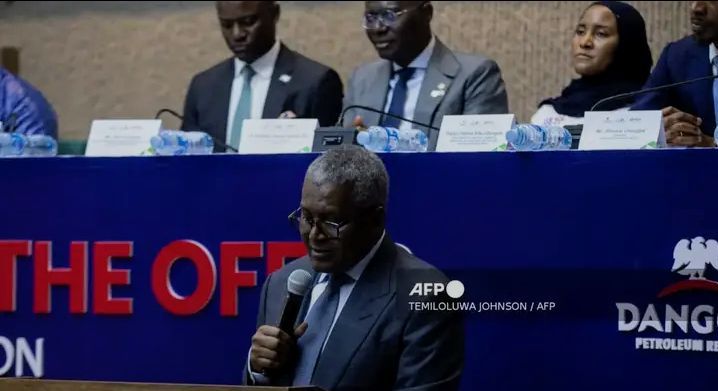
Nigerian billionaire Aliko Dangote, the Ethiopian government and Djibouti are set to develop a $660 million refined petroleum products pipeline aimed at strengthening fuel supply infrastructure and reducing transportation costs between Ethiopia and Djibouti.
The project, which was disclosed on Thursday by a spokesperson in the office of Ethiopian Prime Minister Abiy Ahmed, will involve the construction of a 120-kilometre pipeline connecting the two East African countries.
The development will also include petroleum storage facilities with a combined capacity of about 1.175 million cubic metres in Djibouti and Ethiopia.
According to the Ethiopian government, the pipeline is expected to become operational within 18 months.
Prime Minister Abiy announced the project during a visit to Djibouti, where he met with Djiboutian President Ismail Omar Guelleh and Dangote.
Abiy said on X that the project would be developed through a partnership between Ethiopian Investment Holdings and Dangote Group.
The planned pipeline will run from Damerjog in Djibouti to Dewele in Ethiopia.
Damerjog will host approximately 375,000 cubic metres of petroleum storage capacity, while another 800,000 cubic metres will be provided at Dewele in Ethiopia.
The project is expected to address some of the logistical challenges associated with transporting petroleum products along the Ethiopia-Djibouti corridor.
According to the announcement, the infrastructure is designed to reduce logistics costs and delays while strengthening energy security and improving supply chain resilience in both countries.
The Ethiopia-Djibouti corridor is an important trade route for Ethiopia, a landlocked country that relies heavily on Djibouti for access to international markets and the importation of key commodities, including petroleum products.
The proposed pipeline is therefore expected to provide a more direct infrastructure network for the movement and storage of refined petroleum products between the two countries.
The project further expands Dangote Group’s investments and interests across Africa, particularly in the energy and industrial sectors.
Dangote Group already has several investments in Ethiopia, including a reported $4 billion fertiliser project and power plant, as well as a polypropylene packaging facility.
The latest investment comes as the Nigerian industrialist continues to expand his energy interests beyond Nigeria.
Meanwhile, Dangote and the Kenyan government are expected to break ground next week for a proposed 700,000-barrel-per-day crude oil refinery in Lamu.
The planned Kenyan refinery represents another major expansion of Dangote’s activities in East Africa’s energy sector.
Dangote has in recent years expanded from cement and manufacturing into large-scale investments in refining, fertiliser production, petrochemicals and other areas of the energy value chain.
The $660 million Ethiopia-Djibouti pipeline is expected to add another major infrastructure asset to the group’s growing portfolio across the continent when completed.

NIPCO Group has announced plans to develop a Floating Liquefied Natural Gas (FLNG) project in Nigeria, with the proposed investment estimated at more than $3 billion.
The project, which would mark NIPCO’s entry into the Liquefied Natural Gas (LNG) sector, is expected to have an LNG production capacity of approximately three million metric tonnes per annum, subject to the outcome of ongoing feasibility studies, regulatory approvals and a final investment decision.
The Managing Director of NIPCO Group, Nagendra Verma, disclosed this on Thursday at a press conference, stating that the company was evaluating potential locations in the Escravos area of Delta State and the Akwa Ibom region.
Verma explained that the final location would be determined after the completion of the ongoing feasibility studies, with the company considering sites that would provide access to upstream gas resources, processing facilities, marine transportation and both domestic and international markets.
“This proposed development is envisaged to comprise an FLNG facility along with associated marine and export infrastructure with the potential to serve both the international LNG market and growing domestic LNG demand in Nigeria,” he said.
According to him, the proposed project is currently estimated to require an investment of more than $3 billion.
He, however, stressed that the projected capacity and investment size remained subject to further technical and commercial assessments, as well as regulatory approvals and the company’s final investment decision.
Project assessment ongoing
Verma said NIPCO had been evaluating the FLNG project for between six and nine months and was currently undertaking preliminary technical, commercial and feasibility assessments.
He said the company was examining different development concepts, technology options, financing structures and commercial models to determine the most technically viable and commercially sustainable approach.
The proposed development will comprise an FLNG facility and associated marine and export infrastructure.
The infrastructure is expected to support LNG supplies to international markets while also providing opportunities to meet Nigeria’s increasing domestic demand for gas.
“The project is presently envisaged to have an LNG production capacity of approximately three million tonnes per annum,” Verma said.
“However, this remains subject to the outcome of the ongoing feasibility and technical studies, project economics, regulatory approvals and final investment decisions.”
NIPCO considers indigenous construction
The NIPCO managing director also disclosed that the company was considering opportunities for significant local participation in the development of the proposed project, including the use of indigenous construction and engineering capabilities where technically and commercially feasible.
He said the company was assessing the infrastructure and supply-chain requirements that would be necessary to deliver the project while also examining the potential contribution of Nigerian companies to different aspects of its development.
The company is also evaluating the shipping and logistics infrastructure needed to support both export and domestic LNG distribution.
According to Verma, the ongoing assessment covers upstream gas availability and reserves, FLNG technology and configuration, LNG production capacity, marine and export infrastructure, domestic LNG supply opportunities, shipping and logistics, project economics and financing arrangements.
The proposed investment comes amid efforts to expand Nigeria’s gas utilisation and strengthen its position in the global LNG market.
NIPCO said further decisions on the project would be taken after the completion of the relevant technical and commercial studies and other regulatory processes.
-
 Security2 months ago
NDLEA Declares Alleged Drug Kingpin, Three Associates Wanted, Freezes ₦9.8bn Linked to Syndicate
-
 National Affairs2 months ago
ICPC Uncovers 908 Suspected Ghost Workers Across 50 Federal MDAs, Recovers ₦942 Million
-

 Business/Finance2 months ago
How to Apply for Tunde Onakoya’s ₦250 Million Scholarship Programme and Free Laptop Offer
-
 Politics2 months ago
Atiku Challenges Tinubu to Reveal Details of ₦15.13bn SUV Procurement in 2026 Budget
-

 Judiciary | Public Safety2 months ago
INEC Tells Court Voter Information Is Not Confidential in Emeka Ike’s ₦10bn Lawsuit
-
 Judiciary | Public Safety2 months ago
Court to Rule Friday on NDLEA’s Bid to Destroy ₦480bn Meth Lab in Ogun
-
 Security2 months ago
Family Paid ₦50 Million Ransom to Secure Release of Abducted Kebbi Judge
-

 News2 months ago
2026 Budget: FG Earmarks ₦962.83bn for SUVs, Empowerment Projects Amid Debt Concerns